How to Bet on Greyhounds — Types, Odds & Step-by-Step Guide
 Available in US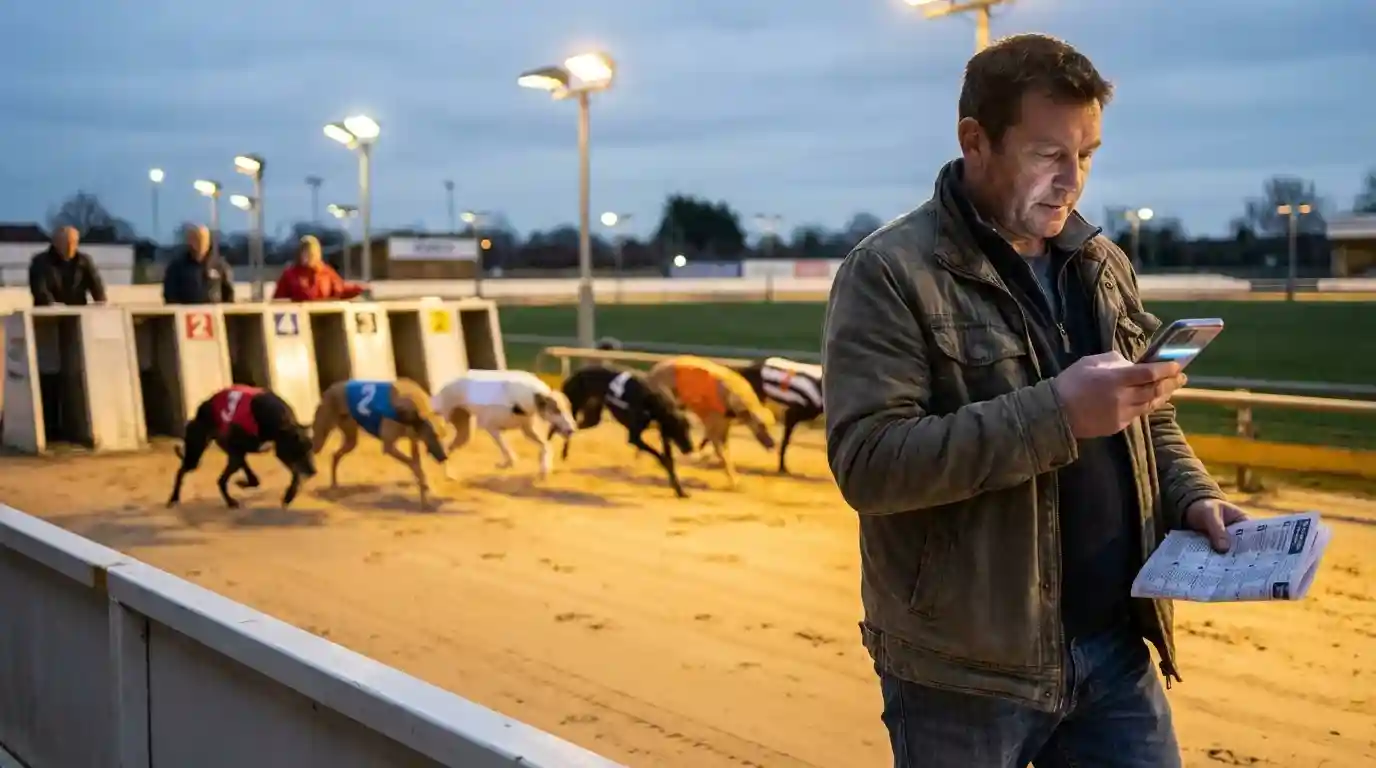
Greyhound Betting Isn’t Complicated — It’s Just Different
If you have bet on horses, you already know roughly 70 per cent of how greyhound betting works. The mechanics are familiar — pick a runner, choose a bet type, place a stake, collect if you are right. The other 30 per cent, though, is where greyhound racing becomes its own discipline entirely. Smaller fields, shorter races, different form indicators, and a pace of competition that leaves horse racing standing at the starting gate.
UK greyhound racing runs more than 80 meetings a week across 18 licensed tracks. Races go off every twelve to fifteen minutes during a typical evening card, and BAGS (Bookmakers’ Afternoon Greyhound Service) fixtures fill the daytime schedule with further action. Each race features six dogs — always six in the UK — launched from numbered traps on a sand oval, chasing a mechanical hare over distances that range from roughly 210 metres in sprints to over 1,000 metres in marathon events. The entire affair is over in under thirty seconds for a standard middle-distance race. That speed is part of the appeal and part of the challenge.
This guide is built for people who want to place informed greyhound bets, whether you are completely new to the sport or migrating from another form of racing. It covers every bet type available in UK greyhound racing, explains how odds are formed and what Starting Price actually means, walks through the process of placing a bet on your phone, and flags the mistakes that cost beginners money before they have had time to learn why. No jargon without explanation, no theory without application.
Greyhound betting rewards preparation. The fields are small enough that genuine analysis is possible in the time between races, and the data — form figures, trap statistics, sectional times, grade movements — is increasingly accessible through modern betting apps. The sport does not demand expertise to enjoy, but it does repay attention. What follows is the groundwork for paying that attention properly.
How a Greyhound Race Works Before You Bet
Six dogs, one trap each, thirty seconds of organised chaos. Before you can bet sensibly on a greyhound race, you need to understand the mechanics of what you are watching — not the biology of the dogs or the history of the sport, but the structural facts that determine outcomes.
Every race at a licensed UK track is run under rules set by the Greyhound Board of Great Britain (GBGB). The six runners are each assigned a numbered trap — 1 through 6 — with a corresponding jacket colour: red, blue, white, black, orange, and black-and-white stripes. The trap number is not random. Dogs are seeded into traps by the racing manager based on their running style: natural railers (dogs that hug the inside) tend to be drawn in lower-numbered traps, while wide runners are placed in higher traps. This seeding matters more than casual bettors realise, because the starting position shapes the entire race.
When the mechanical hare passes the traps, the lids spring open and the dogs sprint toward the first bend. In a standard middle-distance race — typically 460 to 500 metres — the run from the traps to the first turn is where the race is often decided. Dogs that break fast and reach the bend in front have a structural advantage: they take the shortest route around the turn, avoid traffic, and establish a lead that is difficult to surrender on a tight oval. Dogs that break slowly or get crowded at the first bend spend the rest of the race trying to recover lost ground.
The track surface is sand, and sand behaves differently in wet and dry conditions. Rain slows the track, increases running times, and alters which dogs handle the conditions best. The going is reported on the racecard — normal, slow, or fast — and it is worth checking before you bet.
Races are graded. The GBGB grading system ranks dogs by ability within each track, from A1 (the strongest runners at that venue) down to A8 or lower. Open races sit above the grading system and attract the best dogs at any given track. Maiden races sit below, reserved for dogs that have not yet won a graded event. The grade tells you the standard of competition — a dog winning easily in A7 is not necessarily impressive, while a dog finishing third in A2 may be running against significantly stronger opposition. Ignoring grade context is one of the most common errors new greyhound bettors make.
The result is declared by a photo-finish camera at the winning line. Distances between finishers are measured in lengths and fractions of a length, and the official time is recorded for each race. All of this data — the finishing position, the distance beaten, the time, the going, the trap drawn — feeds into the form record that you will see on the racecard next time the dog runs. That form record is the raw material of greyhound betting, and learning to read it is the difference between betting and guessing.
Every Greyhound Bet Type — From Simple to Exotic
Start simple, then decide how complex you want to get. Greyhound betting offers the same spread of bet types as horse racing, but the six-dog field makes certain wagers — particularly forecasts and tricasts — more approachable than they are in larger-field sports. The permutations are manageable, the form analysis is contained, and the dividends can be substantial when you get the finishing order right.
What follows is every standard bet type available on UK greyhound racing, from the straightforward win bet to the combination tricast. Each one has a place, and each one has situations where it makes sense and situations where it does not.
Win Bets and Place Bets
A win bet is the simplest wager in greyhound racing. You pick a dog, you stake your money, and if that dog crosses the line first, you collect at the quoted odds. If it finishes anywhere else, you lose your stake. No complications, no partial returns, no moving parts.
A place bet pays out if your dog finishes in one of the designated place positions — typically first or second in a six-runner greyhound race. The odds on a place bet are lower than on a win bet because the probability of placing is higher than the probability of winning. Most bookmakers do not offer standalone place betting on greyhounds as a prominent market, but it exists through each-way betting, which combines a win and place bet into a single wager.
Win betting is where most greyhound bettors should start and where many experienced ones stay. The logic is clean: you are asking one question — does this dog win? — and the answer is binary. There is no ambiguity about partial returns, no complex settlement rules, and no doubled stakes eating into your bankroll. For most races, a well-reasoned win bet at a fair price is the most efficient use of your money.
Each-Way Betting on Greyhounds
An each-way bet is two bets in one: a win bet and a place bet, at equal stakes. If you place a five-pound each-way wager, you are staking ten pounds total — five on the dog to win at full odds, and five on the dog to place at a fraction of those odds. In UK greyhound racing, the standard each-way terms are 1/4 of the win odds for two places (first and second).
If your dog wins, both parts pay out. You collect the win portion at full odds and the place portion at one quarter of those odds. If it finishes second, only the place part pays, and you lose the win stake. If it finishes third or worse, both parts lose.
The critical detail that many bettors overlook is the break-even point. At 1/4 the odds for two places, a dog needs to be priced at 5/1 or longer for the place return to generate a meaningful net profit when the dog places but does not win. At 4/1, a place finish roughly returns your total stake with no profit. Below 4/1, a place finish actually produces a net loss — you backed a dog each way, it placed, and you still lost money. Each-way on short-priced greyhounds is one of the quietest bankroll drains in the sport.
Each-way works best on longer-priced dogs — 5/1 and above — where you have a genuine view that the dog will finish in the top two but you are not confident enough to back it for the win only. It is a precision tool with a narrow range of effective application, not a default setting for every bet.
Straight Forecast, Reverse Forecast and Combination Forecast
A straight forecast asks you to name the first and second finishers in exact order. Dog A first, Dog B second — no other outcome pays. The appeal is the dividend. Because you are predicting two positions rather than one, and in a specific sequence, the return is significantly higher than a win bet. In a competitive six-dog race, forecast dividends routinely reach 30, 50, or well beyond 100 times your stake when the result involves a less-fancied runner.
The payout on most greyhound forecasts is determined by the Computer Straight Forecast (CSF), a formula-based dividend calculated after the race using the starting prices of the first two finishers. You do not know the exact return before the race — unlike a win bet where you can lock in fixed odds. Some bookmakers offer fixed-odds forecasts, but the CSF generally returns better value over time.
A reverse forecast covers both permutations of your two selected dogs: A first and B second, or B first and A second. It costs twice the straight forecast because it is two bets, but it removes the need to predict the exact order. If either arrangement comes in, you collect the CSF dividend for the actual result. Reverse forecasts make sense when you are confident about the two dogs but genuinely uncertain which one finishes ahead.
A combination forecast extends the principle further. You select three or more dogs, and the bet covers every possible first-and-second permutation among them. Three selections produce six combinations. Four produce twelve. The cost scales with the number of lines, so a one-pound combination forecast on four dogs costs twelve pounds. The wider you go, the higher your strike rate but the higher the break-even threshold — the CSF needs to exceed your total outlay for the bet to profit.
In six-dog fields, combination forecasts on three or four selections offer a practical middle ground: manageable cost, reasonable coverage, and the potential for a dividend that makes the exercise worthwhile. Going wider than four selections in a six-runner race starts to feel like you are paying to cover most of the field — at which point the economics rarely justify the stake.
Tricast and Combination Tricast Explained
A tricast is a forecast with an additional layer of difficulty: name the first, second, and third finishers in exact order. In a six-dog race, there are 120 possible permutations for the top three positions (6 x 5 x 4). A straight tricast targets one of those 120. The implied probability, even before you factor in form, is less than one per cent. The dividends reflect that difficulty — tricast returns in the hundreds are common, and four-figure payouts occur when an outsider fills one of the three places.
The Computer Tricast (CT) formula calculates the dividend based on the starting prices of the first three finishers. As with forecast dividends, the presence of a longer-priced runner in the top three inflates the payout substantially. A result that goes entirely to form might return 20 or 30 to a one-pound stake. A result involving a 10/1 shot in third can push the dividend past 300.
A combination tricast removes the exact-order requirement. You select three or more dogs and the bet covers every possible ordering of three from your selections into the first three positions. Three dogs produce six permutations. Four dogs produce 24. The cost scales accordingly, and the break-even threshold rises with each additional selection. Combination tricasts work best in genuinely open races with no short-priced favourite — the kind of field where a large dividend is likely regardless of which specific order the top three finish in.
Tricasts are not everyday bets. They are high-variance propositions suited to races where you have a strong opinion about three specific dogs and the field is competitive enough to generate a worthwhile dividend. Stake small, be selective, and treat them as a supplement to your core win and forecast betting — not a replacement for it.
Accumulators and Multiple Bets on Dog Racing
An accumulator combines multiple selections into a single bet. Every selection must win for the bet to pay out. The returns from each winning leg roll forward as the stake for the next, producing a compounding effect that turns modest individual prices into headline payouts. A four-fold accumulator on four dogs at 3/1 each returns 256 times your stake — on paper. In practice, the probability of all four winning is roughly 1.5 per cent, which means you are looking at one winner in every 65 attempts.
The appeal is obvious. The maths is less friendly. Every additional leg multiplies not just the potential return but also the bookmaker’s margin. A five per cent edge on a single bet becomes roughly 20 per cent across a four-fold. Accumulators are structurally profitable for bookmakers and structurally unprofitable for the majority of punters who place them.
That does not make them pointless. Placed with small stakes, built from selections you would have backed as singles anyway, and limited to three or four legs where you have genuine form-based opinions, accumulators add a layer of excitement and occasional reward. The discipline is in the stake size: limit acca stakes to one or two per cent of your bankroll, expect to lose most of them, and treat the occasional winner as a bonus rather than an income stream.
Several bookmakers offer acca insurance on greyhound multiples — if one leg loses and the rest win, your stake is returned as a free bet. The value of this promotion depends on the number of legs and the individual odds involved, but it is worth checking the terms before placing any accumulator of four or more selections.
How Greyhound Odds Work — SP, Early Prices and BOG
Odds are not just numbers on a screen — they are the market’s collective opinion about each dog’s chance of winning, expressed in a form that also tells you exactly what you stand to gain if you are right. Understanding how greyhound odds are formed, how they move, and when to lock them in is a practical skill that directly affects your returns over time.
Greyhound markets are thinner than horse racing or football. Six-runner fields produce a simpler pricing structure, but the margins bookmakers build into those prices can vary more than bettors realise. The difference between getting 7/2 and 3/1 on the same dog at the same track on the same evening is a measurable gap in profitability over hundreds of bets. It pays to understand the system rather than passively accepting whatever number appears on your screen.
Fractional Odds and Decimal Odds for Dog Racing
Fractional odds — 3/1, 5/2, 11/4 — are the traditional format in UK greyhound racing. The first number is the profit you receive for every unit of the second number staked. At 3/1, a one-pound bet returns three pounds profit plus your one-pound stake, for a total of four pounds. At 5/2, a two-pound bet returns five pounds profit plus the two-pound stake, totalling seven pounds.
Decimal odds express the same information differently. A dog at 3/1 fractional is 4.0 in decimal. The decimal number is your total return per unit staked — multiply your stake by the decimal price and you have the total payout, including your original stake. Decimal 4.0 means a one-pound bet returns four pounds total. Decimal 3.5 (equivalent to 5/2) returns 3.50 from a one-pound stake.
Most UK betting apps default to fractional odds but allow you to switch to decimal in the settings. Neither format contains more or less information — they are two ways of stating the same thing. Use whichever you find easier to calculate with. The only practical consideration is that decimal odds make comparison slightly faster when you are scanning prices across multiple bookmakers, because you are comparing single numbers rather than fractions. For quick mental calculations during a fast-moving greyhound card, that speed can matter.
Starting Price vs Fixed Odds in Greyhound Betting
The Starting Price (SP) is the official odds on a dog at the moment the traps open. It is determined by the state of the on-course market at the instant the race begins. If you do not actively take a price before the race — by clicking to accept specific odds on your betting app — your bet is settled at SP by default. This is the most common settlement method in UK greyhound betting, and it is also the one that gives you the least control over the price you receive.
Fixed odds, by contrast, are the price you lock in when you place the bet. If you back a dog at 5/1 at ten o’clock in the morning, your bet pays at 5/1 regardless of whether the SP turns out to be 3/1 or 7/1. You have agreed to a contract: this price, this stake, this outcome.
Best Odds Guaranteed (BOG) eliminates the downside of taking early prices. Under BOG terms, if the SP is higher than the fixed odds you accepted, the bookmaker pays you at the better price. If the SP is lower, you keep the price you took. Either way, you get the best available number. BOG is offered by most major UK bookmakers on greyhound racing, though coverage varies — some restrict it to televised meetings or specific fixtures. For any bettor who routinely takes early prices, using a bookmaker with BOG active on greyhounds is not optional. It is the closest thing to a free edge that exists in regulated sports betting.
The practical rule is straightforward: if BOG is available, take early prices whenever you have a view. You lock in a floor with unlimited upside. If BOG is not available, the decision is more nuanced. Publicly fancied dogs tend to shorten as money arrives throughout the day — take the price early if you agree with the crowd. Less obvious runners sometimes drift, and waiting for SP can deliver a longer price. In greyhound racing, where fields are small and on-course markets are thin, SP tends to be relatively stable. But “relatively stable” is not the same as “optimal,” and the difference between the two compounds over a season of betting.
How to Place a Greyhound Bet on Your Phone — Step by Step
Open the app. Here is exactly what happens next.
Every major UK betting app follows a similar flow for placing a greyhound bet, and the process takes less than a minute once you know where things sit. The specifics of button placement vary between operators, but the logical sequence is universal: find the meeting, read the racecard, select your dog, choose your bet type, set your stake, and confirm.
Start by navigating to the greyhound racing section. On most apps this sits under a “Racing” or “Greyhounds” tab, sometimes grouped alongside horse racing. You will see a list of the day’s meetings — afternoon BAGS cards and evening fixtures — ordered by time. Tap the meeting you want. This opens the racecard for the next race at that venue, showing all six runners with their trap numbers, recent form, odds, and basic information such as trainer, weight, and grade.
Read the racecard before you do anything else. Check the form figures, note the trap draw, glance at the going, and see whether any dog has been stepped up or down in grade. The racecard is your decision-making tool. Skipping it and going straight to the odds is the fastest way to turn betting into gambling.
Once you have identified your selection, tap the odds next to the dog’s name. This adds the selection to your bet slip, which usually appears at the bottom of the screen. The bet slip shows the dog, the current odds, and a field for entering your stake. Type in the amount you want to wager. Below the stake field, the app will display the potential return — what you stand to win if the bet is successful.
If you want to place anything other than a win single — an each-way bet, a forecast, a tricast — the bet slip or racecard interface will offer options. For each-way, there is typically a toggle or checkbox labelled “E/W” that splits your stake into win and place components. For forecasts and tricasts, you select multiple dogs and the app prompts you to choose the bet type: straight forecast, reverse forecast, combination forecast, or the tricast equivalents. The interface guides you through assigning finishing positions if you are placing a straight forecast or tricast.
Before confirming, check three things. First, verify the odds — they can change between the moment you add the selection and the moment you confirm, particularly in the final minutes before a race. Second, confirm the stake is what you intended. Third, check the bet type — it is surprisingly easy to accidentally place a win single when you meant to tick the each-way box. Once you are satisfied, hit the “Place Bet” button. The app will confirm the bet and add it to your open bets section, where you can track its progress.
Five Beginner Mistakes in Greyhound Betting
Every punter makes these at least once. The goal is not to avoid them entirely — some lessons only stick through experience — but to recognise them early enough to limit the damage.
Ignoring the grade. A dog with two wins from its last four runs looks strong on paper. If those wins came in A8 and the dog is now running in A5, it is stepping into materially stronger company. The market might price it as a form horse, but it has never proven it can compete at this level. Grade context transforms how you read form. Without it, you are reading numbers in a vacuum.
Betting every race on the card. A twelve-race evening card does not contain twelve opportunities. It might contain three, or two, or on some nights none at all. The compulsion to have a bet on every race — because the next one is only twelve minutes away — is the single fastest route to bankroll erosion in greyhound betting. Selectivity is not passive; it is the most active decision you make.
Treating each-way as a default. Ticking the each-way box on every bet regardless of odds feels prudent. The arithmetic says otherwise. At prices below 4/1 in greyhound racing, a place finish on an each-way bet loses you money. The doubled stake on short-priced each-way wagers drains your bankroll quietly over a season of regular betting. Use each-way when the odds justify it — 5/1 or longer — and back to win only when they do not.
Chasing losses across random meetings. You lose on the 7:30 at Romford. The 7:42 at Sunderland is about to go off. You have no view on the race, no knowledge of the dogs, but the temptation to get your money back before the evening is over proves irresistible. Chasing is not a strategy — it is an emotional reaction to loss, and it almost always compounds the damage. Set a loss limit before you start, and walk away when you reach it.
Ignoring trap draw. In a six-dog race on a tight oval, where the dogs start determines how they navigate the first bend, and the first bend often determines the finishing order. A dog that looks good on form but is drawn in a trap that historically underperforms at that track is facing a headwind the racecard does not make obvious. Trap statistics are publicly available, track-specific, and free. Not checking them before you bet is leaving information on the table.
From Racecard to Wager — Your Move
You now know more than 90 per cent of people placing their first greyhound bet tonight. You understand the race structure, the bet types, how odds are formed, and why grade and trap draw matter. That is not expertise — expertise takes hundreds of races and a willingness to learn from the ones you got wrong — but it is a foundation that puts you ahead of anyone operating on instinct alone.
The temptation from here is to plunge into a full card and back every race. Resist it. Start with one meeting. Watch a couple of races before you bet. Study the racecard for the third or fourth race, apply what you have learned about form and trap draw, and place a single, considered win bet at a stake you are comfortable losing entirely. See how the race unfolds. Compare what happened to what you predicted. Note where you were right and where the race surprised you.
Greyhound racing rewards patience more than confidence. The fields are small, the data is accessible, and the racing is relentless — there will always be another meeting, another race, another opportunity to put your analysis to work. The bettors who last in this sport are not the ones who bet the most. They are the ones who learn the fastest, stake the smallest proportion of their bankroll, and treat every racecard as a puzzle worth solving rather than a prompt to act.
The app is open. The card is loaded. Read it properly, then decide.
