In-Play Greyhound Betting Guide
 Available in US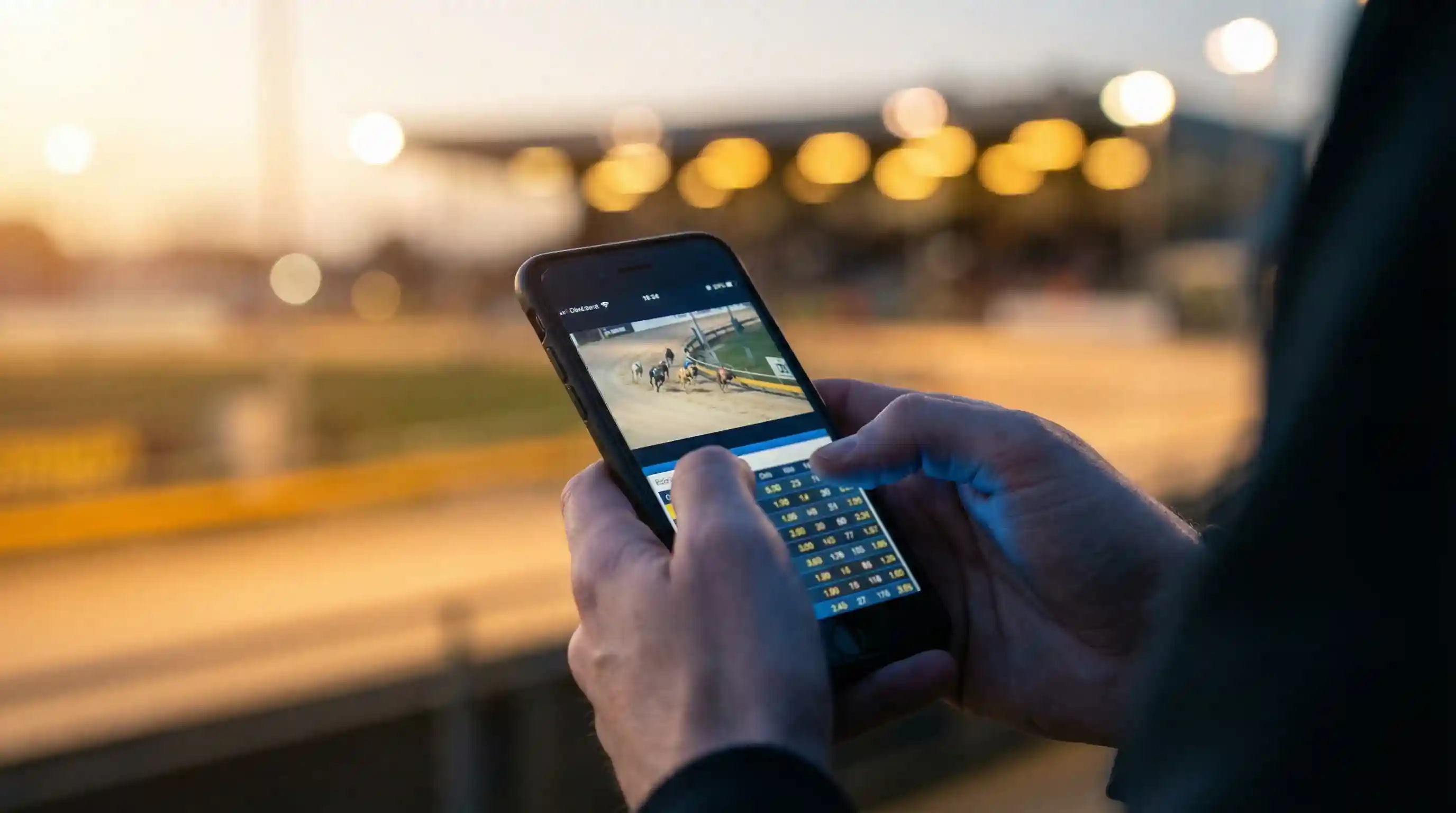
In-Play Betting on Greyhounds — Fast, Risky, Rewarding
The race lasts 30 seconds. Your window to bet in-play is even shorter. In-play greyhound betting is the most compressed form of live wagering in any sport — a market that opens, moves violently, and closes before you’ve had time to reconsider. That speed is simultaneously what makes it appealing and what makes it dangerous.
Unlike football or tennis, where in-play markets evolve over minutes or hours, a greyhound race from trap release to finish line covers roughly 25 to 35 seconds depending on the distance. The in-play market during that window is thin, fast, and reactive. Odds swing based on the first bend, the running positions, and the visual trajectory of each dog as it moves through the race. There’s no time for deep analysis. There’s barely time for a conscious decision.
And yet in-play betting on greyhounds exists, it’s available on most major UK betting apps, and a subset of bettors use it consistently. The question isn’t whether it works — it does, for some people, some of the time — but whether the conditions under which it’s profitable are narrow enough that most bettors should approach it with extreme caution. They are. This guide explains the mechanics, identifies the situations where in-play can add genuine value, and doesn’t shy away from the considerable risks involved. For an overview of how greyhound bet types work, see Timeform’s bet types guide.
How In-Play Betting Works on Greyhound Apps
The app updates odds in real time. Here’s how the mechanic works. When a greyhound race goes in-play on a betting app, the pre-race market closes and a new set of odds appears. These odds are algorithmically generated based on the dogs’ running positions, their estimated probabilities of winning from that point in the race, and the bookmaker’s own liability model. Unlike pre-race prices, which are set with some element of human judgement and market pressure, in-play odds are almost entirely machine-driven.
On most apps, the transition from pre-race to in-play happens the moment the traps open. The odds display changes — typically the interface shifts to show a simplified view with rapidly updating prices. You’ll see each dog’s current odds flickering every second or so as the race unfolds. To place a bet, you tap the odds, enter a stake, and confirm. The process is identical to pre-race betting except that the odds you see when you tap may not be the odds you get. Most apps include an acceptance delay or a price-change notification that asks you to confirm if the odds have moved between your tap and the bet placement.
The key technical reality is latency. The odds you see on your screen are always slightly behind what’s happening on the track. The app receives positional data from the track, processes it through the pricing model, and displays the result — a chain that takes fractions of a second but, in a race lasting half a minute, fractions of a second matter. If you’re watching a live stream on the same app, the stream itself carries additional delay — typically two to five seconds behind the actual race. That means the image you’re watching and the odds you’re seeing are both trailing reality, and they may not even be trailing by the same amount.
This latency issue is fundamental to understanding in-play greyhound betting. You are never betting on what’s happening now. You are always betting on what happened a moment ago, priced according to a model that updated a moment before that. The faster the race moves, the more that lag matters. In a football match, a two-second delay is negligible. In a greyhound race, two seconds is roughly 8% of the entire event.
The markets themselves are typically limited to win only. Forecast, tricast, and each-way bets are not available in-play on any major UK platform. The minimum stakes may also differ from pre-race minimums, and maximum payouts are almost always lower. Bookmakers are understandably cautious about exposure on a market that moves this fast and carries this much uncertainty.
When In-Play Greyhound Bets Make Sense
Not every race is suitable. Not every moment is right. In-play betting on greyhounds is only worth considering in a narrow set of circumstances, and even then, it demands pre-race preparation rather than reactive decision-making during the race itself.
The most defensible use of in-play is the pre-planned conditional bet. Before the race starts, you identify a scenario — a specific dog leads off the first bend, or a known front-runner gets trapped behind slower dogs — and decide in advance what you’ll do if that scenario materialises. The race starts, the scenario either happens or it doesn’t, and you act on the plan you’ve already made. This removes the biggest danger of in-play betting, which is making impulsive decisions under time pressure. Your brain does the analysis before the traps open; your fingers just execute the instruction during the race.
One concrete example: you’ve studied the racecard and identified a strong finisher drawn wide in Trap 6. Pre-race, the dog is 5/1 because the market doubts it can overcome the trap draw. You believe the dog will be last or second-last into the first bend but will run on strongly through the second half of the race. You don’t want to back it pre-race at 5/1 because there’s a genuine chance it gets boxed in and never fires. Instead, you wait. If the dog comes out of the first bend in last place — exactly as you predicted — the in-play odds will have drifted to 10/1 or longer. The market is panicking. You’re not. You planned for this position, and the price now reflects an overreaction to the early running. You place the bet.
That kind of in-play bet is based on pre-race analysis, executed against a specific trigger. It’s not gambling on a hunch while watching a stream. The distinction matters, because the edge — if one exists — comes from the analysis, not from the act of betting in-play.
Another scenario where in-play can work is on races with a strong early-pace bias. At some tracks and distances, the dog that leads into the first bend wins the race more than 50% of the time. If you can identify the first-bend leader within the first few seconds — which, with practice and a reliable stream, is possible — backing that dog in-play at slightly reduced odds can be a positive-expectation play. The price you get won’t be as generous as the pre-race price, but the information you’ve gained (the dog is already leading) materially improves the probability of winning.
Outside of these planned scenarios, in-play greyhound betting is largely a reactive exercise, and reactive betting on a 30-second event rarely produces consistent results. The races are too short for mid-race reassessment to be reliable, and the latency issues mean you’re never acting on truly current information.
The Risks of Live Dog Racing Bets
Stream delays, impulsive decisions, and thin markets. Know the dangers. In-play greyhound betting carries risks that are qualitatively different from pre-race betting, and they deserve explicit attention because the format’s speed can make the risks feel smaller than they are.
The stream delay — covered in the mechanics above — is the most technical risk and the one that’s hardest to mitigate. If your live stream trails the actual race by even three seconds, that’s roughly 10% of the event already decided before you see it. A dog that appears to be gaining on your screen may have already been caught. A leader that looks comfortable may have started to tire. The in-play odds, updated from track data faster than your stream, sometimes know things your eyes haven’t seen yet. Betting against a more informed price is a structurally losing proposition.
Impulsive decision-making is the behavioural risk, and it’s the one that costs most bettors the most money. The adrenaline of watching a live race, combined with the availability of a bet button on the same screen, creates a powerful temptation to act without thinking. You see your dog fall behind, the odds drift, and you double down because the price “looks good.” Or you see a different dog take the lead and decide to back it in the moment, with no pre-race analysis behind the decision. These are not bets. They’re reactions. And reactions in a 30-second market are almost always negative-expectation.
Market thinness is the structural risk. In-play greyhound markets are not deep. Bookmakers limit their exposure by restricting maximum stakes, widening the spread between back and lay prices, and reserving the right to reject bets that arrive during rapid price movements. The odds you see may not be the odds you get, and even when you do get them, the bookmaker’s margin is wider than in pre-race markets. You’re paying more for less certainty.
There’s also a psychological pattern worth naming: the chase. A bettor places a pre-race bet, watches the dog run poorly, and then fires an in-play bet on another runner to try to recover the loss within the same race. This is the most destructive in-play behaviour in greyhound betting, and it has nothing to do with strategy. It’s loss aversion dressed up as a second chance.
Speed Demands Discipline
In-play is the sharpest tool in the box. That’s exactly why it cuts both ways. The speed and intensity that make in-play greyhound betting exciting are the same qualities that make it dangerous for anyone who hasn’t built a framework of rules before the first race starts.
If you’re going to use in-play on greyhounds, the framework should be simple and non-negotiable. Decide before the race what your trigger is. Decide what price makes the bet worthwhile. Decide how much you’re willing to stake. If the trigger doesn’t appear, the bet doesn’t happen. If the price isn’t there, the bet doesn’t happen. No exceptions during the race. No adjustments while the dogs are running. The plan is set before the traps open, and the only decision left during the race is whether to press the button or not.
Most serious greyhound bettors don’t use in-play at all. Their analysis is done pre-race, their bets are placed pre-race, and they watch the race as a spectator. That’s not a failure of nerve — it’s a recognition that the information advantage in pre-race markets is larger, the margins are tighter, and the decision-making environment is calmer. In-play is the exception to their method, used sparingly when the specific race setup and their specific analysis create a scenario that’s worth the additional risk.
If you use in-play that way — as a surgical instrument rather than a default setting — it can add a dimension to your greyhound betting that pre-race markets don’t offer. If you use it as a way to chase action, react to visuals, or recover losses, it will accelerate your losses faster than any other bet type available. The tool is the same. The outcome depends entirely on the hand that holds it.
