Greyhound Forecast Bet Explained
 Available in US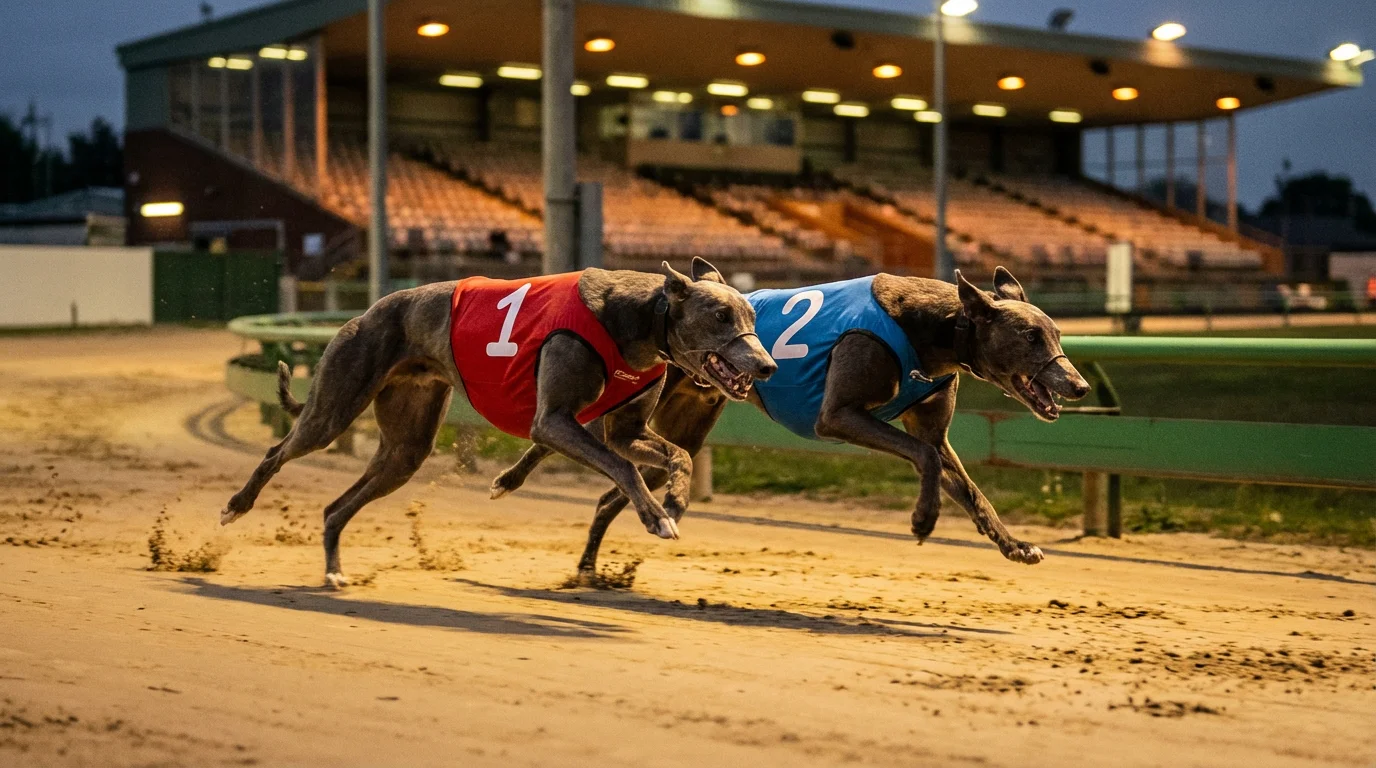
Forecast Betting on Greyhounds — Predicting the Top Two
You’re not just picking a winner anymore — you’re calling the finish order. A forecast bet in greyhound racing asks you to name the first two dogs home, and in its simplest form, you need to get the exact order right. It’s harder than a win bet. It pays considerably more. And in a sport with just six runners per race, it’s far more achievable than most people assume.
Forecast betting is one of the defining bet types of UK dog racing. Walk into any bookmaker’s shop on a weekday afternoon and the majority of greyhound slips coming across the counter will be forecasts or tricasts, not straight win bets. There’s a reason for that. In a six-dog field, the number of possible first-and-second combinations is just 30. Compare that to horse racing, where 12-runner handicaps produce 132 possible forecast outcomes. Greyhound racing’s compact fields make forecasts tractable — you can form a genuine opinion on the top two rather than guessing.
The bet comes in three main forms: straight forecast, reverse forecast, and combination forecast. Each trades off between cost, complexity, and the probability of landing a return. Understanding the differences isn’t optional — it’s the foundation of using forecasts effectively.
What makes forecasts particularly relevant for greyhound bettors is the nature of the sport itself. Races are short, fields are small, and the variables — trap draw, early pace, running style — tend to separate the contenders from the also-rans more cleanly than in most other racing disciplines. If you can read a racecard and picture how the first bend is likely to unfold, you already have the tools to make forecast selections. The question is whether you’re using those tools at the right price.
Straight Forecast vs Reverse Forecast vs Combination Forecast
Three variations, three levels of risk, three different price points. The common thread is that all forecasts require you to select two dogs from the field. What changes is how strictly you need to predict their finishing positions.
A straight forecast is the purest form. You name Dog A to finish first and Dog B to finish second, in that exact order. If Dog A wins and Dog B finishes second, you collect. Any other result — including Dog B winning and Dog A finishing second — and the bet loses. The payout is determined by a Computer Straight Forecast (CSF) dividend, which is calculated after the race based on the starting prices of the two dogs. Because the order must be precise, the returns can be substantial, particularly when the first and second finishers are both at decent prices.
A reverse forecast doubles your coverage. It’s effectively two straight forecasts combined: Dog A first and Dog B second, or Dog B first and Dog A second. Either permutation wins. The trade-off is cost — your stake is doubled because you’re placing two bets. If you’d stake £2 on a straight forecast, a reverse forecast on the same two dogs costs £4. The payout is still the CSF dividend for whichever permutation lands, so the return per unit is the same as a straight forecast. You’re simply paying for flexibility on which dog finishes ahead of the other.
A combination forecast expands the principle further. Instead of selecting two specific dogs, you select three or more and cover all possible first-and-second combinations. With three dogs, there are six possible permutations. With four, there are twelve. Each permutation is an individual bet at your unit stake, so the cost escalates quickly. A £1 combination forecast on three dogs costs £6. On four dogs, it costs £12. The payoff is that you only need any two of your selections to fill the first two places in any order. You don’t need to know which one wins and which one places — just that they both finish in the top two.
For greyhound bettors, the practical decision usually comes down to confidence level. If you’re highly confident in the win selection and moderately confident in the second dog, a straight forecast is the sharpest bet. If you think both dogs will fill the first two places but you’re unsure which will lead, a reverse forecast covers you for double the stake. And if you’ve identified a race where three runners look clearly superior to the rest, a combination forecast lets you back that analysis without needing to nail the exact order.
The mistake many bettors make is defaulting to combination forecasts on every race because they feel “safer.” Covering more permutations costs more, and the CSF dividend has to be large enough to offset the multiplied stake. In races where one dog is a clear favourite, a straight forecast with that dog on top is almost always better value than a combination that includes permutations you don’t genuinely believe in.
How Forecast Payouts Are Calculated
Computer Straight Forecast dividends aren’t set by bookmakers. They’re calculated by an algorithm after the race, using the starting prices of the first two finishers. This is an important distinction because it means you can’t see your exact potential payout before the race — only an estimate based on current odds.
The CSF formula takes the SP odds of the first and second-placed dogs and runs them through a model that accounts for the probability of that specific outcome. The result is a dividend expressed per £1 unit stake. If the CSF returns £45.20, a £1 straight forecast pays £45.20. A £2 stake pays £90.40. The dividend is declared after the race and appears alongside the official result.
What drives the size of the CSF? In simple terms, the longer the odds of both finishers, the bigger the payout. A forecast with a 2/1 favourite finishing first and a 3/1 second favourite placing returns far less than one where a 5/1 shot wins ahead of a 7/1 outsider. The CSF also takes into account the number of runners and the overall shape of the market. In a six-dog greyhound race, the CSF tends to be more generous than in larger horse racing fields because the probability of any specific two-dog combination is naturally higher with fewer runners — but the odds of each individual dog tend to be shorter, which partially offsets that.
Some bookmakers also offer fixed-odds forecasts on greyhound racing, where you can see the exact price before the race. These are typically less generous than the CSF because the bookmaker builds in a margin. However, they offer certainty — you know exactly what you’ll win before the traps open. The choice between CSF and fixed-odds forecast depends on whether you value certainty or expect the CSF to return more. As a general rule, CSF dividends are larger than fixed-odds prices in races where outsiders fill the first two places, and smaller when favourites dominate.
Reverse forecasts and combination forecasts are settled on the same CSF dividend. The key is that only the winning permutation pays, and it pays at the full CSF rate for that specific order of finish. Your total profit is the CSF dividend multiplied by your unit stake, minus the total cost of all the permutations covered.
When Forecast Bets Offer Better Value Than Win Bets
In tight six-dog fields, the forecast can be where the real edge lives. The reason is structural: win odds in greyhound racing are compressed by the small field size. When there are only six runners, even an average dog is rarely priced beyond 10/1 or 12/1. Favourites sit at evens or shorter. The margins between win prices are narrow, which limits how much you can earn from a straight win bet.
Forecasts break out of that compression. Because you’re predicting a specific combination rather than a single outcome, the payouts jump into territory that win bets simply cannot reach in six-dog fields. A CSF of £30 to £50 is fairly routine when two mid-priced dogs fill the top positions. In races where outsiders run first and second, the CSF can comfortably exceed £100. Those returns are transformative for a £1 or £2 stake.
The races that suit forecast betting tend to share certain characteristics. Competitive graded races where no dog has a dominant form edge are ideal — the kind of race where three or four runners have a genuine winning chance and the other two are honest but limited. In these fields, predicting the winner alone isn’t especially profitable because the odds are clustered. But layering a second selection into a forecast — particularly one you’ve identified through trap draw analysis or running style — multiplies the return without proportionally increasing the difficulty.
Forecast betting also shines in races where you have a strong opinion on the likely runner-up. That sounds unusual, but it happens more often than you’d think in greyhound racing. A dog with blistering early pace from a favourable trap might be a near-certainty to lead into the first bend but has a history of fading in the closing stages. Backing that dog to win is risky. But using it as the second leg of a forecast — behind a stronger finisher — turns a weakness into an asset.
The discipline required is straightforward: don’t place a forecast unless you have a genuine view on both positions. Randomly pairing the favourite with a second dog you haven’t analysed is not forecast betting — it’s hoping, and the CSF won’t bail you out often enough to justify the approach.
Forecasts Reward Precision — And That’s the Point
Anyone can pick a winner. Naming the first two? That’s a skill. And that’s exactly why forecast betting occupies the space it does in greyhound racing — it rewards the punter who does the extra work. Not more work, necessarily, but different work. The kind that involves reading the racecard for second-place clues, not just first.
The advantage forecasts offer is that they compensate you for insight that a win bet ignores. If you’ve identified that Trap 3 has strong early pace and will lead, and that Trap 6 always finishes strongly at this distance, a win bet on either dog captures only one dimension of your analysis. A straight forecast captures both. The return reflects the difficulty of the prediction, and that’s where the value sits.
Greyhound racing is one of the few betting environments where forecasts are genuinely accessible. Six runners, race-by-race data, trap draw statistics, and reliable form lines give you enough information to form a view on the first two home. In larger-field horse racing, forecasts are often a punt. In dog racing, they can be a considered opinion backed by data.
The trap — if you’ll pardon the pun — is overcomplicating it. Combination forecasts on five dogs, multi-race forecast accumulators, elaborate permutation strategies: these are the domain of bettors looking for action, not value. The strongest forecast bettors tend to be the simplest. One straight forecast per race, grounded in form and trap analysis, placed at a consistent unit stake. When it lands, it pays well. When it doesn’t, the loss is small and defined. Over the course of a meeting, one winning forecast at a £30 CSF covers a lot of losing singles.
Forecasts are not easier than win bets. They’re harder, by definition, because you need to get two things right instead of one. But in greyhound racing, that additional difficulty comes with a payout structure that more than compensates for it. If you can read a race well enough to identify the first two home, even some of the time, forecasts should be part of your regular betting approach.
