Greyhound Betting Strategy UK — Traps, Form & Staking Plans
 Available in US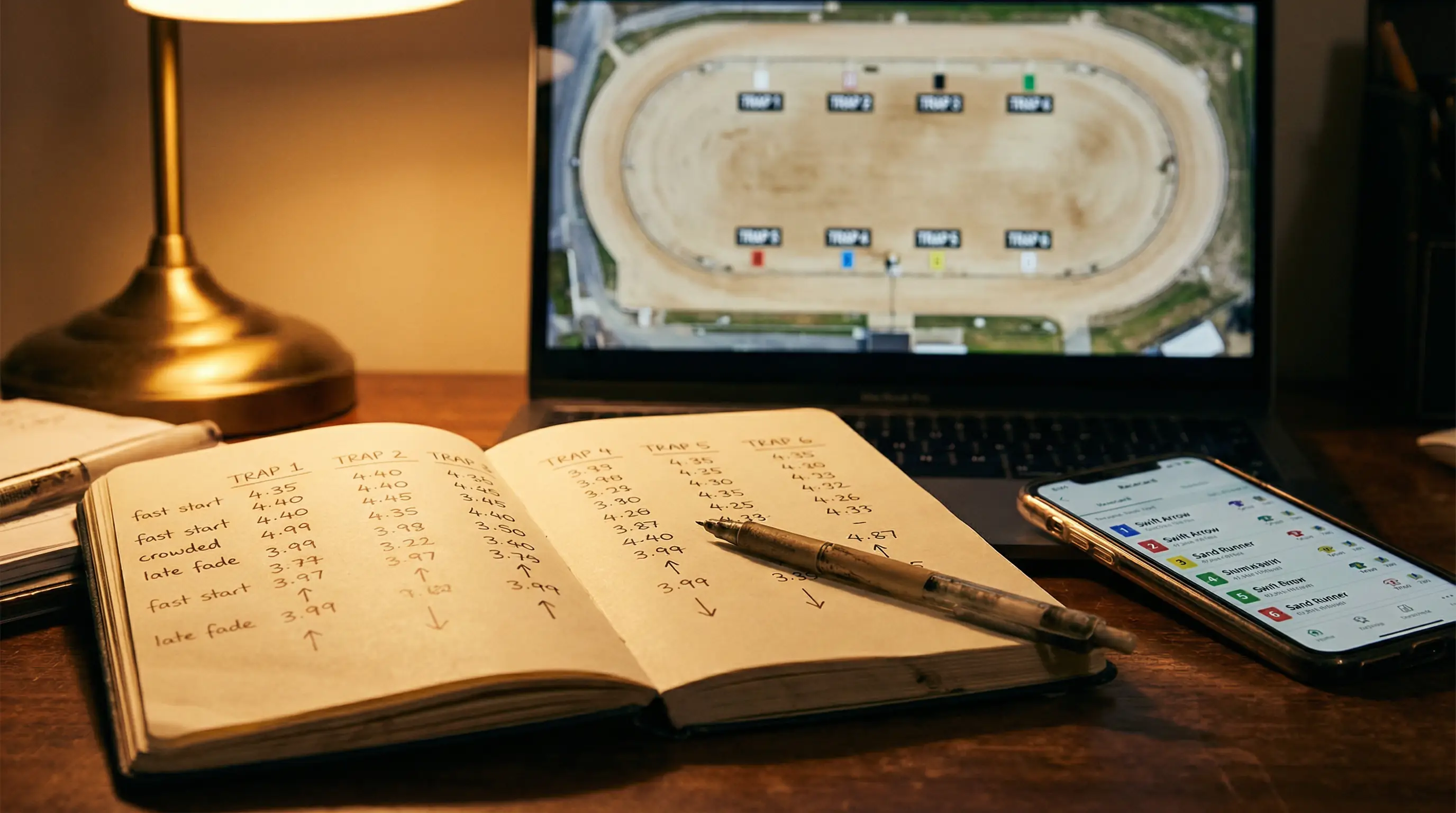
Greyhound Betting Strategy Starts With the Right Questions
Forget systems. Start with this: what do you actually know about the race you are betting on?
Every worthwhile greyhound betting strategy begins not with a formula but with an honest assessment of information. Do you know this track? Have you checked the trap statistics for this distance? Do you understand the grade — and what it means that Dog A just stepped up from A5 while Dog B dropped down from A3? Is the going normal, or did it rain all afternoon? These are not complicated questions. They are the questions that separate bettors who have a method from those who are simply picking names.
Greyhound racing attracts system-sellers and tipsters promising guaranteed returns. None of them can deliver that promise, for the straightforward reason that a six-dog race with live odds, variable conditions, and real animals does not produce guaranteed anything. What a disciplined approach can deliver is a positive expected value over time — not on every bet, not even every week, but across a sustained period of selective, informed wagering. The strategy is not complex. It requires no proprietary software and no subscription service. It requires data that is publicly available, a staking method that protects your bankroll, and the discipline to walk away from races where you do not have an edge.
This guide covers the three pillars of practical greyhound betting strategy: trap analysis, form reading for value, and staking discipline. It also addresses market timing — when to take a price and when to wait — and the exchange angle for bettors who want to lay dogs rather than back them. There is no shortcut here. There is a framework, and frameworks work only when applied consistently.
Trap Analysis — The Foundation of Greyhound Betting
In a six-dog race on a tight oval, where they start dictates where they finish — not always, but often enough to matter. Trap analysis is the first layer of any serious greyhound betting strategy because it addresses the structural variable that exists before a single dog moves a muscle. The trap number determines the angle to the first bend, the proximity to the rail, the probability of interference, and the spatial relationship between each runner and every other runner in the field. That is a lot of influence for a number printed on a jacket.
The reason trap analysis matters more in greyhound racing than in most other sports is geometry. Six dogs break from adjacent boxes and converge on a bend within three to five seconds. On tight-turning tracks, the inside-drawn dog saves multiple lengths of ground through the first turn. On more galloping circuits, the advantage is diluted but rarely eliminated entirely. These geometric effects accumulate across thousands of races and produce measurable, persistent biases that are track-specific and distance-specific. Ignoring them is not a neutral choice — it is choosing to operate without data that is freely available and demonstrably relevant.
How to Use Track-Specific Trap Statistics
The correct way to use trap data is as a calibration tool, not a selection system. You do not back Trap 1 at Romford in every sprint regardless of the dog. You look at the form, assess the runners, and then check whether the trap draw supports or undermines your preliminary view. A dog that looks strong on form and draws a statistically favourable trap is a stronger proposition than the same dog in a weaker draw. That marginal adjustment, applied consistently, compounds over hundreds of bets.
Trap statistics must be sourced at track level and — critically — at distance level. A track that shows an even distribution across traps at 480 metres might display a pronounced Trap 1 bias at 260 metres, because the sprint distance amplifies the geometric advantage of the inside rail. Aggregating all distances into a single trap statistic for a venue masks these distinctions. The GBGB does not publish a centralised trap dashboard, but third-party sites and Timeform compile win rates by trap, track, and distance.
Update your data regularly. Trap biases shift over time as tracks undergo maintenance — resurfacing, bend re-profiling, hare rail adjustments — and as seasonal weather patterns alter how the surface behaves. A trap that dominated through the summer might show a more balanced record once winter rain softens the sand. Checking the last 30 to 60 days of results at any track you bet on frequently takes minutes and keeps your analysis current.
Running Styles and How They Interact With Trap Position
Dogs are not interchangeable units that respond identically to the same trap draw. Each has a running style — front-runner, railer, middle-runner, wide-runner, closer — and that style interacts with the trap position to produce a specific race scenario. A natural railer drawn in Trap 1 is in its element: close to the rail from the start, saving ground through the bends, and likely to establish position early. The same railer drawn in Trap 6 faces an immediate problem: it needs to cross five lanes of traffic to reach its preferred line, losing ground and risking interference in the process.
Running style information is encoded in the racecard through form comments and trap history. A dog that repeatedly shows ALd (Always Led) from inside traps is a front-running railer. One that shows RnOn (Ran On) from wide draws is a closer that prefers space. Racing managers at UK tracks seed dogs into traps based on their running preferences, which means the draw is not random — but the seeding is not always a perfect match, particularly in graded races where the available runners may not align neatly with ideal trap positions.
The strategic application is to look for alignment between style and draw — and to identify mismatches. A front-runner drawn wide faces a harder path to the lead than the form alone suggests. A closer drawn inside may be forced into early pace battles it would prefer to avoid. When you see a mismatch, adjust your assessment downward for that dog’s chances. When you see a strong alignment — a fast-breaking railer in Trap 1 at a track that favours the inside — you have a convergence of factors that the market sometimes underprices.
Reading Form for Value — Not Just for Winners
The favourite wins roughly 35 per cent of graded UK greyhound races. That is a meaningful strike rate — higher than in horse racing — but it also means the market-leader loses nearly two-thirds of the time. The edge in greyhound betting does not come from identifying winners with certainty. It comes from identifying situations where the probability of a dog winning — or placing — is higher than its odds imply. That gap between probability and price is value, and finding it requires reading form with more nuance than a glance at the last few finishing positions.
Value exists in two directions. A dog might be underpriced — its odds are shorter than its genuine chance warrants, making it a bad bet even though it might win. Or it might be overpriced — its odds are longer than justified, making it a good bet even though it might lose. Your job as a form reader is not to predict the winner. It is to assess whether the price on offer for any given dog represents a fair return relative to the risk. That assessment demands context: grade, trap draw, going, recent race comments, and the quality of the opposition.
Spotting Value When Dogs Change Grades
Grade movement is one of the most reliable sources of value in greyhound racing. When a dog drops in grade — moving from A3 to A4, for example — it is now facing weaker opposition than it recently competed against. If its form in the higher grade showed competitive performances — finishing third or fourth against better dogs, close to the winner, perhaps with race comments like RnOn or Crd indicating it ran well despite trouble — then the drop in grade puts it among runners it is likely to beat. The market sometimes adjusts slowly to grade drops, pricing the dog based on its recent losing record rather than the reduced quality of today’s field.
The reverse scenario — a dog stepping up in grade after a run of wins — is a value trap for the unwary. Two wins from three at A7 looks impressive. But if the dog is now running in A5, those wins came against inferior opposition, and the step up represents a genuine test. The market often overvalues recent winners without accounting for the grade of those victories. A dog promoted two grades on the back of low-level wins is frequently overbet and frequently beaten.
Check the CLASS column for each of the dog’s recent runs. Map the grade direction. Ask whether the current grade is one where the dog has proven it can compete, or one where it is being tested for the first time. The answer changes how you read every other piece of form on the card.
Distance Changes and Their Impact on Results
When a dog switches distance — from a standard middle-distance race to a sprint, or from middle-distance to a staying event — the form profile changes. A dog that has been fading in the closing stages of 480-metre races might be better suited to a 270-metre sprint, where the race ends before its stamina runs out. A dog with strong closing sectionals but persistent mid-pack finishes might thrive over an extra 100 metres, where its endurance becomes the decisive factor.
Distance switches are relatively common in UK greyhound racing, particularly for dogs that have been underperforming at their current trip. Trainers experiment, and the racecard will show the new distance alongside the dog’s previous runs at different distances. The key question is whether the dog’s sectional profile — its pattern of pace — matches the demands of the new distance. Fast early sectionals with declining closing speed suggest a sprinter. Even splits or improving closing sections suggest a stayer. The sectional data, when available, provides a factual basis for predicting how the distance switch will play out.
The market often misprices distance-switch runners because their recent form at the old distance looks poor. A dog finishing fifth in four consecutive 480-metre races has a losing record. But if its sectional profile shows strong closing pace that never had time to convert into a result at that trip, and it is now entered over 640 metres, the apparent poor form is misleading. The dog has not suddenly improved — it has been placed in a race that suits its natural running pattern. These situations are where form reading earns its keep.
Staking Plans That Work for Greyhound Bettors
Every pound you bet should be a decision, not a reflex. The selection process gets most of the attention in greyhound betting — which dog, which race, which price — but staking is the structural decision that determines whether your selections produce long-term profit or long-term loss. A 60 per cent strike rate at poor odds with reckless stakes will lose money. A 30 per cent strike rate at value odds with disciplined stakes can generate a profit. The staking plan is what converts good analysis into sustainable returns.
Two staking methods dominate practical greyhound betting: level stakes and percentage staking. Both are simple. Both work. The choice between them depends on your bankroll size, your betting frequency, and how much variance you can tolerate without deviating from the plan.
Level Stakes — The Simplest Approach That Actually Works
Level-stakes betting means wagering the same fixed amount on every qualifying bet. If your stake is five pounds, every win bet, every forecast, every selection that meets your criteria receives a five-pound stake. No exceptions for confidence, no doubling up after a loss, no reduced stakes after a win. The amount is constant.
The strength of level staking is its discipline. It removes emotion from the staking decision entirely. You cannot chase losses by increasing your bet after a losing run, because the plan does not allow it. You cannot overcommit on a race you feel especially confident about, because the plan does not allow that either. The uniformity acts as a behavioural guardrail that protects against the two most common staking errors: overexposure on high-confidence bets that lose, and underexposure on lower-confidence bets that win.
Set your level stake as a percentage of your total bankroll — typically between one and three per cent. A bankroll of 200 pounds supports level stakes of two to six pounds per bet. This sizing ensures that a losing run, which is inevitable in greyhound betting, does not threaten the entire bankroll. A string of fifteen consecutive losers at three-pound stakes costs 45 pounds from a 200-pound bank — painful but survivable. The same losing streak at 20-pound stakes wipes the bank out entirely.
Percentage Staking and Bankroll Protection
Percentage staking adjusts the bet size relative to your current bankroll. Instead of a fixed amount, you wager a fixed percentage — typically one to two per cent — of whatever your bankroll is at the time of the bet. If your bankroll grows, your stakes increase proportionally. If it shrinks, your stakes decrease, automatically reducing exposure during losing periods.
The advantage over level staking is bankroll protection during drawdowns. In a sustained losing run, percentage staking reduces the absolute amount you risk on each subsequent bet, making it mathematically harder to exhaust your bankroll entirely. The disadvantage is that during a winning run, the increasing stake can lead to larger losses when the run ends — and it always ends. Percentage staking also requires recalculating your stake before every bet, which adds a small friction that level staking avoids.
For most recreational greyhound bettors — those with a defined bankroll, betting on three to five meetings a week — level staking is the simpler and more practical choice. Percentage staking becomes more relevant for higher-volume bettors or those operating with larger bankrolls where the absolute amounts on a level-stake basis might become uncomfortably large during a winning period. Either method works. Neither works if you abandon it the moment a losing streak tests your patience.
When to Bet — Early Prices, Late Moves and Market Signals
The greyhound market moves fast. Prices are published in the morning, adjusted through the afternoon as money arrives, and finalised at trap rise in the evening. Understanding when to act — and when to wait — is a tactical lever that most recreational bettors never touch, but one that measurably affects returns over a season of regular betting.
Early prices, typically posted by mid-morning, represent the bookmaker’s opening assessment based on form, ratings, and anticipated market behaviour. These prices are estimates, not verdicts. If a dog attracts public support throughout the day — through tips in newspapers, social media buzz, or simply because its form is obvious — the price shortens. If a dog is ignored, it drifts. Taking an early price on a dog you believe will shorten protects you from that compression. You lock in value before the rest of the market arrives.
The presence of Best Odds Guaranteed (BOG) transforms this decision. With BOG active, you take the early price and also receive the benefit of any drift — if the SP is higher than the price you took, you are paid at the better number. This makes taking early prices with a BOG bookmaker almost always the rational choice. You have a floor with unlimited upside. Without BOG, the calculation is more nuanced: take early if you expect the price to shorten, wait if you think it will drift.
Late market moves — significant price changes in the final minutes before a race — carry information. A dog that shortens sharply from 5/1 to 3/1 in the last ten minutes is attracting serious money. That does not guarantee it will win, but it suggests that informed opinion — possibly from connections, trainers, or experienced punters who have watched the dog’s recent trials — favours that runner. Conversely, a morning favourite that drifts to a bigger price by trap rise is losing support, which may signal doubts about its condition or form that are not visible on the racecard.
Monitoring market moves requires either watching the prices on your app throughout the afternoon or using odds comparison tools that flag significant changes. For most bettors, the practical approach is simpler: decide on your selection in the morning, take the early price with BOG where available, and let the market do what it does. Chasing late market moves on every race is time-consuming and often leads to reactive rather than analytical betting.
Lay Betting on Greyhounds — The Exchange Angle
You do not always need to pick the winner. Sometimes it is easier to identify the loser. Lay betting — available through betting exchanges like Betfair Exchange — allows you to bet against a dog winning. Instead of backing Dog A to win, you lay Dog A, which means you profit if it finishes anywhere other than first. You are, in effect, acting as the bookmaker for that selection.
The appeal in greyhound racing is that six-runner fields make lay betting more tractable than in larger-field sports. If you can identify one dog in the field that is overpriced — its odds are shorter than its actual chance warrants — laying it at that price gives you a positive expected value. The dog you lay needs to lose, and in a six-runner race, even the market leader loses more often than it wins. Laying a vulnerable favourite at a short price is one of the more sustainable approaches in exchange greyhound betting.
The risk is clearly defined: if the dog you lay wins, you owe the backer their winnings. Your liability on a lay bet is the odds minus one, multiplied by the backer’s stake. Laying a dog at 3/1 for five pounds means your liability is ten pounds — the amount you lose if it wins. Managing lay liability is essential. Overlaying — taking on too much risk on a single race — can produce losses that dwarf the steady accumulation of small profits from successful lays.
The practical limitation is liquidity. Greyhound exchange markets are significantly thinner than horse racing or football. Getting large stakes matched, particularly on BAGS meetings and lower-grade races, can be difficult. The exchange works best for greyhound laying on feature meetings, televised races, and open events where betting volumes are higher. On quieter cards, the market may be too thin to execute your lay at the price you want.
The Only Honest Edge in Dog Racing
There is no magic formula. There is only better preparation, more discipline, and a willingness to walk away from bad races.
The edge in greyhound betting is not a secret piece of knowledge or a proprietary algorithm. It is the compound effect of doing ordinary things consistently: checking trap statistics before you bet, reading form comments rather than just finishing positions, understanding grade context, comparing prices across bookmakers, taking BOG when it is available, and staking a fixed proportion of your bankroll on every qualifying bet. None of these actions is complex. All of them are skipped, inconsistently, by the majority of bettors most of the time.
The honest truth about greyhound betting is that most punters lose money over the long term. The bookmaker’s margin ensures this at the aggregate level. The minority who break even or profit do so by exploiting the margin’s weakness: it is applied uniformly across all prices, but the actual probability of each dog winning is not uniform. Find situations where the true probability exceeds what the odds imply, bet selectively on those situations, and manage your stakes so that the inevitable losing runs do not destroy your bankroll before the winning ones arrive. That is the strategy. Everything else is implementation.
The races that offer the best opportunities are not always the feature events. They are the races where you have done the work — where your analysis of form, trap draw, grade, and going gives you a view that differs from the market. Some weeks that might be three races. Some weeks it might be zero. The discipline to accept zero — to close the app and wait for a better card — is the hardest part of any greyhound betting strategy, and the part that separates those who last from those who do not.
