Live Greyhound Streaming — Best Apps for Watching UK Races
 Available in US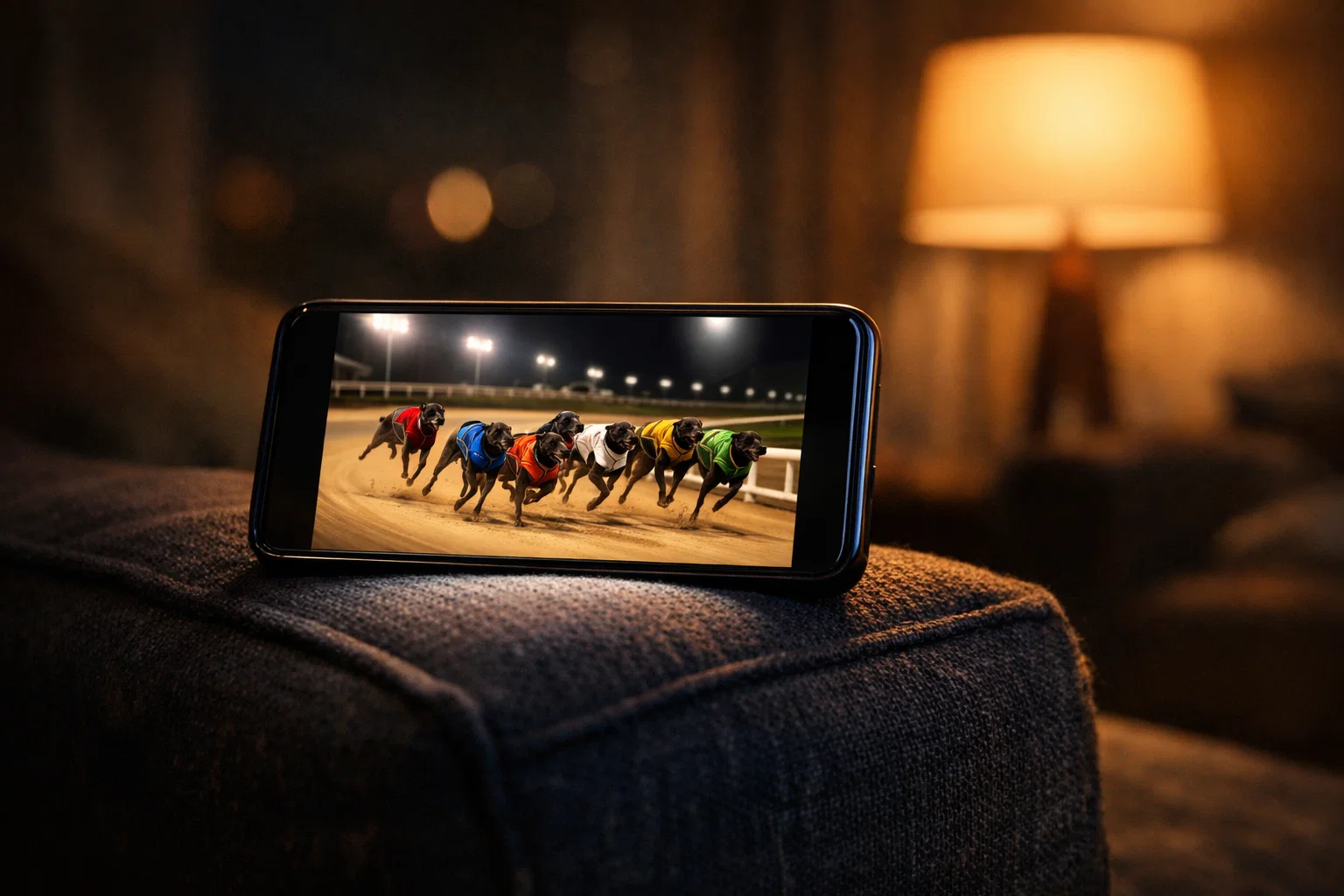
Why Live Streaming Changed Greyhound Betting Forever
Betting blind on dogs was normal for decades. You studied the form, picked your dog, placed your money, and waited for the result to appear as a line of text on a screen or a voice on a betting shop speaker. The race itself was something that happened elsewhere — at a track you might never visit, between dogs you would never see run. You backed numbers, not animals.
Live streaming ended that. When bookmaker apps began embedding race feeds directly into their platforms, the entire relationship between bettor and race changed. Suddenly you could watch the traps open, see how your dog broke, follow the first-bend scrimmage, and know — before the official result appeared — whether you had won or lost. More importantly, you could watch races you were not betting on, building a visual library of how dogs actually run rather than relying solely on the compressed shorthand of form figures and race comments.
The informational value of streaming is where the real shift happened. A result tells you who won, by how much, and in what time. It does not tell you why. It does not show you the dog that was hampered at the first bend and lost three lengths, the closer that was gaining fast but ran out of track, or the favourite that broke slowly and never recovered. Streaming shows all of that. Over time, watching races — even briefly, even casually — produces a richer understanding of form than any amount of data analysis conducted in isolation.
In 2026, live greyhound racing is accessible through every major UK betting app. The coverage is comprehensive, the access barrier is low, and the feeds run on the same phone you use to place your bets. There is no longer a practical reason to bet on greyhounds without watching them. This guide covers where the streams come from, how each major app delivers them, what you need to access them, and how to extract genuine betting value from what you see on screen.
SIS, RPGTV and At The Races — Which Services Cover What
Three broadcast providers sit behind the greyhound racing you watch on UK betting apps. Each operates different cameras, covers different tracks, and delivers its feed through different distribution arrangements. Understanding which service covers which meetings helps you know what to expect when you open a stream — and explains why certain races look and sound different from others.
SIS (Sports Information Services) Coverage
SIS is the backbone of live greyhound broadcasting in the UK. It operates the camera systems at the majority of GBGB-licensed tracks, produces the race feeds, and distributes them to licensed betting operators — both online and in betting shops. When you watch a greyhound race on a bookmaker’s app or website, you are almost certainly watching a SIS feed.
SIS covers the full UK greyhound fixture list: daytime BAGS meetings, evening cards at licensed tracks, and the standard programme of racing that fills the calendar week after week. The production is functional rather than polished. A typical SIS race broadcast begins with a shot of the dogs being loaded into the traps, cuts to a head-on angle as the lids open, and then follows the action with a tracking camera through the bends and home straight. There is no commentary on most SIS feeds distributed through bookmaker apps — you watch in silence or with ambient track noise.
For experienced bettors, the absence of commentary is not a drawback. You do not need someone explaining what you can see for yourself. The camera captures the full race, and that is the information you need: how each dog breaks, what happens at the first bend, which runners encounter trouble, and how the race unfolds from there. SIS delivers this consistently across almost every meeting on the UK schedule.
Racing Post Greyhound Television (RPGTV)
RPGTV provides a different layer of coverage. Launched in December 2011, it offers dedicated greyhound programming with commentary, form previews, and post-race analysis — the editorial context that SIS feeds lack. RPGTV has been available on Sky, Freesat, and Freeview, though the channel’s availability and scheduling have shifted over the years as the broadcast landscape has evolved.
Sky Sports Racing, which rebranded from the At The Races channel in January 2019, also covers selected greyhound meetings alongside its horse racing schedule. Since January 2024, Premier Greyhound Racing (PGR) has held an exclusive agreement to broadcast greyhound racing on the channel, with a dedicated red button service and live streaming on the greyhounds.attheraces.com website. The coverage here is more selective than SIS — not every meeting is shown — but the production quality is notably higher, with informed commentary that adds context for both new and experienced viewers.
For bettors who want to understand the narrative around the racing — which dogs are attracting attention, which trainers are in form, how the card is likely to shape up — these editorial services add value that a silent SIS feed cannot provide. Whether that value justifies a Sky subscription depends on how much greyhound racing you watch and how much you rely on the commentary to inform your betting. Most regular punters treat bookmaker streaming via SIS as the primary source and editorial coverage as a useful supplement for feature meetings and major events.
How Greyhound Streaming Works in Each Major App
Not all apps stream the same tracks, and the quality gap is real. Every major UK bookmaker app offers greyhound streaming, but the scope of coverage, the video quality, the interface integration, and the ease of switching between the stream and the racecard vary more than you might expect. These differences matter if you watch races regularly, because the stream is not just entertainment — it is the visual layer of your form analysis, and a clunky viewing experience undermines that purpose.
The following is how the major operators handle greyhound streaming specifically. General app reviews tell you about football and horse racing interfaces. This is about what happens when you navigate to the dogs.
Bet365 Live Greyhound Streaming
Bet365 is generally considered the strongest all-round option for greyhound streaming. The coverage is comprehensive — virtually every UK meeting carried by SIS is available, including daytime BAGS fixtures and evening cards. The stream loads within the racecard page, meaning you can watch the race and view the form data for the next event without navigating away. On mobile, the video sits at the top of the screen with the racecard scrollable beneath it, and picture-in-picture mode is supported on both iOS and Android.
The access requirement is straightforward — a funded account or a small qualifying bet, depending on the current terms. The stream quality is adequate for mobile viewing: clear enough to identify trap colours and follow the race action, though it can look soft on larger screens. The feed delay is typically a few seconds behind real time, which is acceptable for form-watching purposes but worth remembering if you are considering in-play bets.
Where Bet365 stands out is the integration between stream and bet slip. You can watch a race, assess how a dog runs, and place a bet on its next outing without leaving the greyhound section. That seamless loop — watch, analyse, bet — is the practical advantage of a well-designed streaming interface, and Bet365 executes it more smoothly than most competitors.
William Hill, Coral, Ladbrokes and Betfred Streaming
William Hill streams greyhound racing across most UK meetings, with the feed accessible through the racecard page. The coverage is comparable to Bet365 in breadth, and the stream quality is similar — functional on mobile, serviceable on desktop. William Hill also tends to post greyhound prices early, which suits bettors who want to watch morning trials or study the card before committing to a selection. The app handles picture-in-picture reasonably well, though the transition between stream and bet slip is slightly less fluid than Bet365’s implementation.
Coral and Ladbrokes, both part of the Entain group, share a similar streaming infrastructure. Coverage extends to most SIS-distributed meetings, and the feed embeds within the racecard view. Coral has historically offered slightly more prominent greyhound promotions, and the racecard draws on Timeform data for form analysis. Ladbrokes mirrors this closely. Both apps support live streaming on mobile and desktop, with the usual requirement of a funded account or a small qualifying bet to unlock the feed.
Betfred streams greyhound racing with coverage that covers the major UK fixture list, though the depth of meetings available can fall slightly short of the top-tier operators on quieter racing days. The app is functional for streaming, with the feed available through the standard race event page. Betfred’s interface is clean but less information-dense than Bet365 or the Entain platforms — bettors who want rich racecard data alongside their stream may find themselves supplementing with an external form service.
Across all four operators, the underlying feed is the same SIS production — the differences are in how the app presents it, how easily you can navigate between the stream and your bet, and how much supporting data sits alongside the video. For bettors who primarily want to watch races and check results, any of these apps will serve. For those who use streaming as an active part of their analysis — watching how dogs run, noting trouble in running, and feeding that information into future selections — the integration quality matters, and it is worth testing before committing your primary activity to a single platform.
What You Need to Access Free Live Greyhound Streams
Free does not always mean unconditional. Every bookmaker that streams greyhound racing attaches at least a minimal access requirement, and the specifics vary between operators. Knowing what is needed before you try to watch avoids the frustration of opening an app two minutes before a race and discovering you cannot see the feed.
The most common requirement is a funded account. This means your betting account must have a positive balance — in many cases, even a penny qualifies. You do not need to bet on the specific race you want to watch; you simply need money in the account. This is the lowest barrier and the one most operators use as their default access gate for greyhound streams.
Some bookmakers require a qualifying bet. Rather than just holding a balance, you need to have placed a bet — typically a minimum of one pound — within a defined window, often the last 24 hours or on the specific meeting you want to watch. This requirement is slightly more restrictive but still trivial for anyone who is actively betting. If you are using streaming primarily to watch and learn rather than bet, the qualifying-bet requirement means you need to place at least a token wager to maintain access.
A few operators offer streams with no qualifying conditions beyond having a registered account, though this is less common and terms can change without notice. Always check the specific streaming terms on your bookmaker’s app — they are usually stated in the help section or on the race event page where the stream would normally appear.
Beyond account requirements, the practical needs are standard: a stable internet connection, a device capable of running the bookmaker’s app or website, and sufficient mobile data or Wi-Fi bandwidth to sustain a video stream. Greyhound streams are not high-definition productions — they run at a modest resolution that keeps data consumption reasonable. A standard 4G connection handles them without difficulty. On slower connections, expect occasional buffering, which is irritating but rarely makes the stream unwatchable.
Using Live Streams for In-Play Greyhound Betting
Every race you watch feeds your understanding of the next one. That cumulative effect is where streaming generates its most tangible return — not in the race you are watching now, but in the betting decisions you make for the races that follow.
In-play betting on greyhounds is a narrow window. A standard race lasts roughly thirty seconds, and the in-play market opens at trap rise and closes within moments. The speed makes it impractical for most bettors to react to what they see in real time — by the time you process that your dog has broken slowly, the race is half over. In-play greyhound betting is less about reacting to the race in front of you and more about using the information from one race to inform your betting on the next.
This is where streaming earns its keep as an analytical tool. Watch the first three races on a card. Note which traps produce clean breaks. Observe whether the inside rail is favouring front-runners or whether wide runners are making ground through the bends. Check if the going is producing times consistent with what you expected, or whether rain or track maintenance has changed the surface since the card was published. All of this information is invisible on a results page but obvious on a live stream.
A specific application: watching how the track is running before you bet the later races. If the first three winners all led from Trap 1 or Trap 2, the inside rail is performing well — and if Race 7 has a strong early-pace dog drawn in Trap 1, that observation strengthens the case for backing it. Conversely, if every inside-drawn favourite has been beaten through the first half of the card, the surface or conditions may be neutralising the usual inside advantage. The stream gives you this information in real time. Results alone give you the outcomes without the visual context.
The discipline is in separating observation from impulse. Watching a race is engaging. Watching and immediately wanting to bet the next one because you feel you spotted something is a different proposition. The stream should feed your analysis, not bypass it. Use what you see to refine your pre-race assessment, not to replace it with a gut reaction to thirty seconds of video.
Stream Quality, Delays and Technical Considerations
A three-second stream delay can cost you a bet. That is the hard reality of live streaming through bookmaker apps — the feed you are watching is not truly live. It runs a few seconds behind the actual race, with the exact delay varying by operator, network conditions, and device. For form-watching and post-race review, this delay is irrelevant. For anyone attempting to place in-play bets based on what they see on screen, it is a critical factor.
The delay exists because the stream passes through multiple stages between the track camera and your phone: capture, encoding, distribution through the SIS network, delivery to the bookmaker’s platform, and decoding on your device. Each stage adds latency. Most bookmaker streams run two to five seconds behind real time, which means the dogs on your screen have already finished by the time you see them cross the line. In-play odds adjust closer to real time than the stream does, which creates an asymmetry — the bookmaker’s pricing reacts to the actual race before you have seen it unfold on your feed.
Stream resolution on mobile is adequate but not impressive. The feeds are optimised for low bandwidth rather than high fidelity. You can identify trap colours, follow the pack, and see the general shape of the race without difficulty. What you cannot do on most streams is pick out subtle details — a dog’s stride pattern changing, slight contact between runners that does not cause visible disruption, or the exact moment a dog begins to fade. For these finer observations, track-side viewing or high-quality replays remain superior.
Replays are available on most bookmaker platforms for several hours after each race. They are underused. Watching a replay takes thirty seconds and can confirm or correct what you thought you saw in real time. A dog that appeared hampered at the first bend might look less impeded on a second viewing. A strong finish might look even more convincing when you watch it again without the tension of having money on the result. Building a habit of reviewing replays — even for two or three races per meeting — sharpens your visual form assessment over time.
When Streaming Isn’t Available — Alternatives for Live Info
No stream? You still have options. Streaming coverage is extensive but not absolute. Occasional technical failures, unlicensed meetings, or gaps in a specific bookmaker’s SIS agreement can leave you without a live feed for a race you want to follow. When that happens, several alternatives keep you connected to the action.
Live text commentary is available on some bookmaker apps and racing data sites. It provides a running description of the race as it unfolds — who leads at the first bend, which dogs are making ground, and the finishing order as the dogs cross the line. The updates are delivered in near real time and give you the narrative shape of the race, if not the visual detail. For assessing trouble in running or observing running styles, text commentary is a poor substitute for video. For knowing who won, who was prominent, and how the race unfolded in broad terms, it is serviceable.
Rapid results services update finishing positions, times, and distances within seconds of the race ending. These are the fastest non-streaming source of race information, and they are standard on every major bookmaker app and on sites like the GBGB results page. You will not see the race, but you will know the outcome almost as quickly as someone who watched it live.
Social media — particularly X (formerly Twitter) — carries real-time commentary from greyhound racing followers, tipsters, and journalists. The quality is variable, but during major meetings or feature races, the volume of commentary can give you a sense of how a race played out even without seeing it. This is a supplementary source, not a primary one. Treat social media race updates the same way you would treat any unverified information: useful for context, not reliable for precise detail.
The best fallback, when streaming is unavailable for a race you were planning to bet on, is simply not to bet. If your analysis depended on watching the race — or on watching earlier races to assess the track — the absence of a stream removes a piece of your information set. Betting without it is betting with less data, and less data generally means worse decisions. Sometimes the most disciplined response to a missing stream is a smaller stake or no stake at all.
The Stream Is a Tool, Not a Show
Treat every stream the same way you would treat a piece of form data — with a purpose. The temptation with live racing is to let it become background entertainment: the stream plays, you half-watch, the result comes in, you move to the next race. That is fine for casual enjoyment, but it wastes the analytical opportunity that the video provides.
Three things are worth watching for in every race. First, the break from the traps — how quickly each dog leaves the boxes and what position they reach by the first bend. Second, what happens at the first turn — who gets crowded, who runs free, who loses ground to interference. Third, the closing stages — which dogs are gaining, which are fading, and how the final positions compare to the running order at the last bend. These three observations, made consistently across a full card, build a picture of the meeting that results alone cannot replicate.
The bettors who profit most from streaming are not the ones who watch every race for entertainment. They are the ones who watch with a notebook — literal or mental — recording what they see, cross-referencing it against the form figures, and using the visual evidence to inform their next selection. The stream is free. The time investment is minutes per race. The informational return compounds with every meeting you watch. It is one of the few genuine edges available to recreational bettors, and it asks for nothing more than paying attention.
