Greyhound Hurdle Racing — How It Works & Betting Guide
 Available in US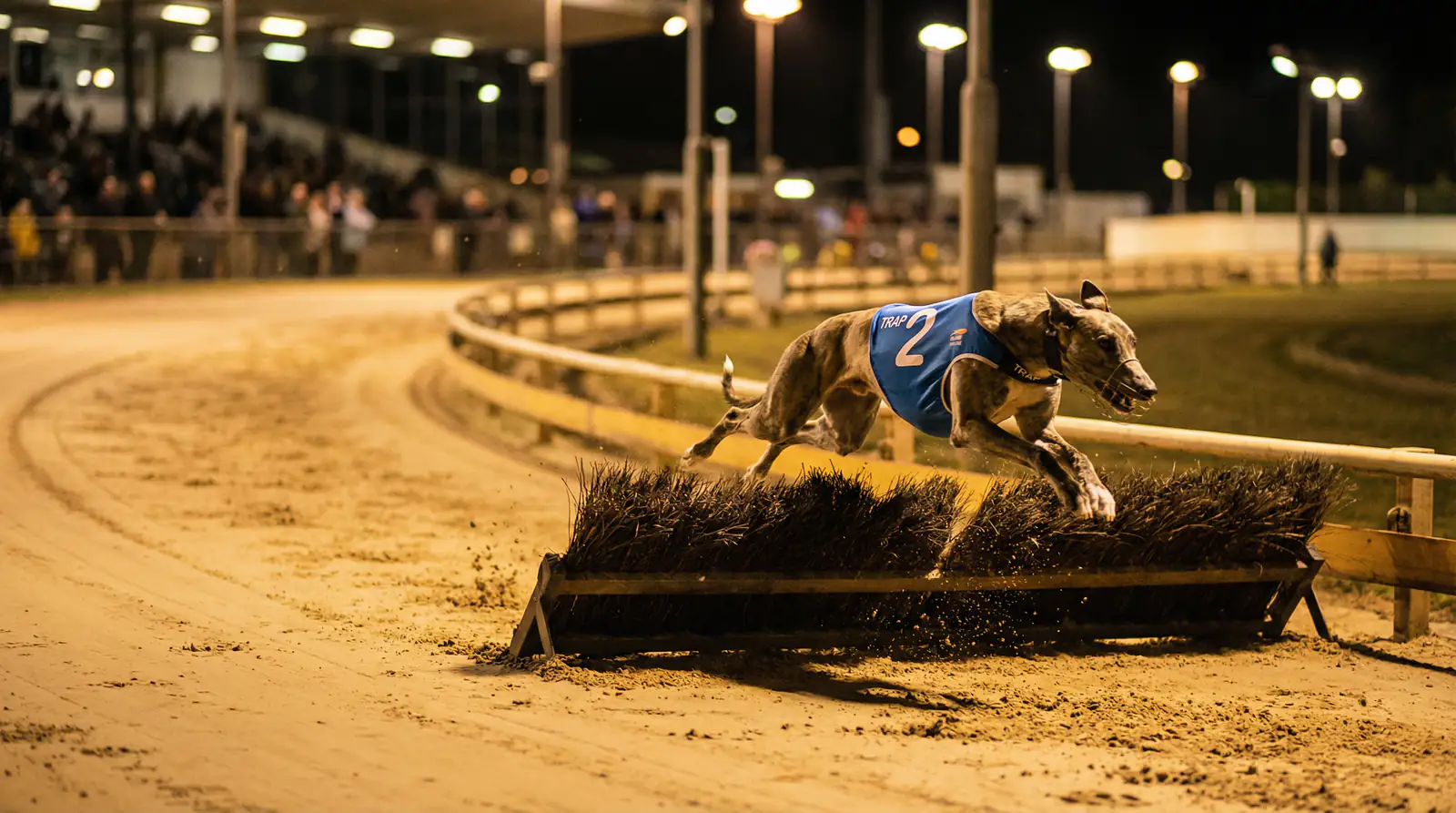
Hurdle Racing — Where Greyhound Racing Meets Jumping
Greyhound hurdle racing is a distinct discipline within the sport — a format where dogs race over a series of low hurdles rather than a flat track. It’s less well known than standard flat racing, runs at fewer tracks, and attracts a smaller betting market. But for the bettors who follow it, hurdle racing offers something flat racing doesn’t: a different set of form variables, a niche market with less competition, and a spectacle that tests a greyhound’s courage as much as its speed.
Hurdle races are run over distances typically longer than standard flat races, usually 480 metres or more, with a set of brush hurdles positioned around the track. The hurdles are low enough that greyhounds clear them in stride rather than making a dramatic jumping effort — this isn’t horse racing’s Grand National. But the hurdles introduce an element that flat racing lacks entirely: the requirement to jump cleanly at speed, repeatedly, while maintaining position in a six-dog field.
Not every greyhound can hurdle. Some dogs are natural jumpers — they take to it instinctively, clearing the obstacles without breaking stride. Others lose momentum at each hurdle, or worse, clip the brush and lose their footing entirely. This variation in jumping ability creates a form dimension that exists only in hurdle racing, and it’s one that the betting market doesn’t always price efficiently.
How Hurdle Racing Differs From Flat Racing
The most obvious difference is the hurdles themselves, but the knock-on effects of those obstacles change the race dynamics in ways that go well beyond simply adding jumps to the track.
Speed matters less and stamina matters more. A hurdle race is longer than a standard flat race, and the repeated effort of jumping — even low hurdles — accumulates over the course of the race. Dogs that rely purely on early pace and have nothing left in the closing stages are more exposed in hurdle races than on the flat, because the hurdles slow them fractionally at each obstacle while stronger stayers maintain their rhythm. The form of a dominant flat sprinter doesn’t translate directly to hurdle racing. The form of a strong stayer with a clean jumping technique often translates very well.
The trap draw is less decisive. On the flat, the inside draw gives a measurable advantage into the first bend. In hurdle racing, the first obstacle arrives before the first bend at most tracks, and all six dogs face the hurdle simultaneously regardless of their starting position. A dog in Trap 6 that jumps cleanly gains as much from its technique as a dog in Trap 1 — the hurdle is the great equaliser in terms of positional advantage. This flattening effect means that hurdle race form is less trap-dependent than flat form, which changes the analytical approach.
Falls and interference are real risks. Unlike flat racing, where collisions happen at the bends and are usually resolved quickly, hurdle racing introduces the possibility of a dog clipping a hurdle, stumbling, or falling. When one dog falls at a hurdle, it can bring down or impede the dog behind it — a chain reaction that doesn’t exist on the flat. This additional randomness increases the variance in hurdle racing, which means that single-race results are less reliable as form indicators than they are on the flat. A dog that finished last might have been going well before being taken out by a faller at the third hurdle. Context matters even more than usual.
Hurdle racing runs at a limited number of UK tracks. Not every venue has the facilities or the track configuration to host hurdle events. This concentrates the hurdle-racing population of dogs at specific tracks, which means the form pool is smaller and the dogs tend to race against each other repeatedly. For bettors, this is actually an advantage: familiarity with the hurdle-racing regulars at a given track builds quickly, and the smaller field of specialists means your knowledge base covers a higher proportion of the runners in any given race.
Betting on Greyhound Hurdles — Markets and Form
Hurdle racing betting markets are available on most major UK apps, though the coverage is less comprehensive than for flat racing. Not every hurdle meeting will appear on every platform, and the odds may be less competitive because the market volume is lower. Bookmakers who offer Best Odds Guaranteed on flat racing don’t always extend the promotion to hurdle events, which is worth checking before assuming the same conditions apply.
Form reading for hurdle races requires additional variables beyond the standard flat analysis. The most important is jumping record — how consistently the dog clears the hurdles without losing ground. Some form services annotate hurdle runs with jumping comments, noting whether the dog jumped cleanly, clipped a hurdle, or was impeded by another runner’s jumping error. These annotations are more valuable than finishing positions alone, because a dog that finished third but jumped perfectly throughout has a cleaner form profile than a dog that won despite clipping two hurdles — the latter was lucky, the former was doing everything right.
Sectional analysis is less useful in hurdle racing because the hurdles disrupt the rhythm of the race in ways that don’t produce consistent splits. A fast first section might reflect a clean jump at the first hurdle rather than genuine early pace. A slow middle section might reflect a dog adjusting its stride to approach a hurdle rather than a loss of form. The overall race time remains meaningful, but sectional breakdowns are less reliable as indicators of running style than they are on the flat.
Trainer data is particularly relevant in hurdle racing. Some trainers specialise in developing hurdle dogs — they have the training facilities, the experience, and the knowledge of which dogs are natural jumpers. A dog from a hurdle-specialist kennel entering a hurdle race is a categorically different proposition from a flat-racing dog trying hurdles for the first time. The trainer’s hurdle record — win rate specifically in hurdle events, not overall — is a data point worth checking before any hurdle bet.
Forecast and tricast betting on hurdle races can produce larger dividends than flat racing equivalents because the additional variance from jumping errors creates more upsets. Favourites in hurdle races are less reliable than on the flat — a clean-jumping outsider at 8/1 has a better chance of upsetting the favourite than it would in a six-dog flat race, because the hurdles introduce opportunities for the market leader to make a costly error. This dynamic makes hurdle races attractive for exotic bet types where unexpected finishing orders produce the largest payouts.
Why Hurdle Racing Attracts a Niche Following
The hurdle-racing community within UK greyhound betting is small but dedicated. The format attracts bettors who appreciate the additional layer of complexity that jumping adds to the sport, and who find value in a market that receives less analytical attention than the main flat racing programme.
The niche factor is itself an advantage. Because fewer bettors study hurdle racing form, the market is less efficient than the flat market. Prices reflect less collective scrutiny, which means that a bettor who develops genuine expertise in hurdle-racing form — understanding jumping ability, stamina profiles, trainer specialisation — is competing against a thinner field of informed opponents. The edge available to a dedicated hurdle-racing bettor is, in principle, larger than the edge available in a heavily analysed flat market.
The spectacle also plays a role. Watching a greyhound clear a series of hurdles at full speed is visually dramatic in a way that flat racing, for all its intensity, doesn’t always match. The risk of falls, the skill required to jump cleanly, and the sight of a strong jumper powering away from the field after the final hurdle creates a viewing experience that engages beyond the purely analytical. Hurdle racing enthusiasts tend to be genuinely passionate about the discipline, which fosters a knowledgeable community whose collective insight can supplement your own form study.
The Hurdles Test Heart, Not Just Speed
Greyhound hurdle racing reveals qualities that flat racing conceals. Courage — the willingness to attack a hurdle at speed rather than hesitate. Consistency — the ability to reproduce clean jumping round after round without becoming careless. Resilience — the capacity to recover from a clipped hurdle and continue racing rather than losing momentum entirely. These are not qualities that appear in standard form data. They emerge only in hurdle competition, and they separate the genuine hurdle specialists from dogs that happen to have tried jumping.
For bettors, hurdle racing is a discipline worth exploring. The markets are less crowded, the form variables are different, and the analysis required goes beyond the standard flat-racing toolkit. If you’re looking for a corner of greyhound betting where expertise is less common and edges are more available, the hurdles are where you’ll find both.
