Greyhound Running Styles Explained
 Available in US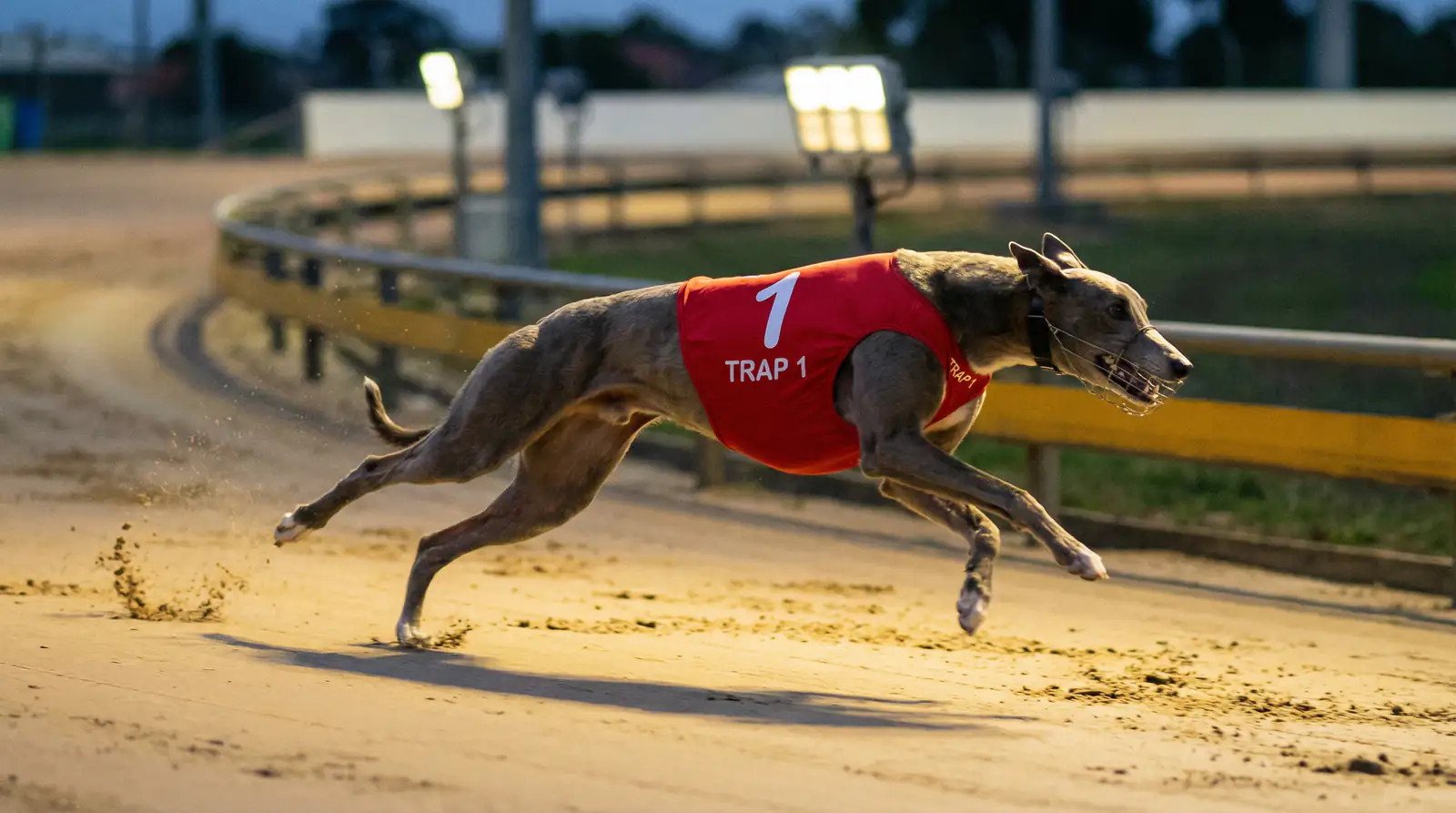
Running Styles — The Hidden Layer in Greyhound Form
Fast out of the traps or strong through the bends? It changes everything. A greyhound’s running style — the way it distributes its effort across the race — is one of the most valuable and most overlooked pieces of information on the racecard. Two dogs can post identical finish times over 480 metres and be fundamentally different athletes: one that sprinted to the front and held on, and one that sat last off the first bend and powered through the field in the second half of the race. Same result, entirely different profiles, entirely different implications for their next outing. For a broader overview of how to read greyhound form, see the At The Races greyhound guide.
Running style matters because greyhound racing is a positional sport. Six dogs in tight formation around an oval track means that where a dog finds itself at the first bend largely determines the shape of its race. A dog with natural early pace gets to choose its position. A dog without it is at the mercy of the field. The trap draw amplifies or mitigates that dynamic, the track geometry shapes it further, and the combination of all six dogs’ running styles in a single race creates a pace scenario that’s unique to that field. Reading those interactions before the race is one of the most useful skills a greyhound bettor can develop.
Form figures tell you what happened. Running style tells you why it happened and, more importantly, what’s likely to happen next time when the field composition is different.
Early Pace, Mid-Pace and Strong Finishers
Three running types, three different betting implications. While greyhound running styles exist on a spectrum, most dogs fall clearly into one of three broad categories, and understanding each one gives you a framework for reading any racecard with more depth.
Early-pace dogs break fast from the traps and look to lead into the first bend. These are the greyhounds whose racecard comments typically read “led from traps,” “fast away,” or “disputed lead.” Their strength is positional: by reaching the first bend in front, they get the inside line, avoid crowding, and control the pace. The best early-pace dogs sustain their speed through the race and win by dictating terms. The weaker ones sprint to the front and then fade, caught in the final straight by stronger finishers. On the racecard, you can identify consistent early-pace dogs by looking for repeated comments about leading or disputing the lead, and by checking sectional times where available — a fast first split relative to the finishing time indicates early speed.
Mid-pace dogs are the most adaptable and often the hardest to read. They break reasonably from the traps — not first out, but not left behind — and settle into a mid-division position through the first bend. Their racing style depends heavily on the pace of the dogs around them. If the early leaders set a strong pace, the mid-pace dog benefits from sitting behind and picking up the pieces late. If the early pace is slow, the mid-pace dog might find itself in a battle for position without the tactical advantage of either leading or finishing fast. Mid-pace dogs tend to produce inconsistent form figures because their results are so dependent on the race dynamics around them. A dog that finishes second in one race and fifth in the next might have run to exactly the same standard — the difference was in who it was racing against and how the pace unfolded.
Strong finishers are the closers — dogs that typically start slowly or mid-division and run on powerfully in the second half of the race. Their racecard comments feature phrases like “stayed on well,” “strong run final straight,” “came from behind,” or “finished fast.” These dogs have stamina and sustained speed rather than explosive early pace. Their challenge is positional: starting behind the field means navigating through traffic, taking wider paths around bends, and losing ground that pure speed has to recover. When the track and trap draw allow them clear running, strong finishers can be devastating. When they’re boxed in or drawn on the outside at a tight track, their finishing speed is wasted because they never get the chance to deploy it.
The betting implications differ for each type. Early-pace dogs are most valuable at tracks with tight bends and short runs to the first bend, where positional advantage is magnified. They’re less reliable at tracks with long straights where closers have room to run them down. Strong finishers offer the best value at standard distances and above, at tracks with wide straights and gradual bends that allow them to make ground without losing too much on the turns. Mid-pace dogs are the chameleons — their value depends entirely on the specific field they’re drawn in and the pace scenario it produces.
How Running Style Interacts With Trap Position
An early-pace dog from Trap 1 at a tight track is a very different bet than the same dog from Trap 6. The interaction between running style and trap draw is where race reading becomes genuinely three-dimensional. Knowing what a dog does is only half the picture — knowing where it does it from, and how the track layout affects that, is the other half.
Early-pace dogs benefit most from inside draws. From Trap 1 or Trap 2, a dog with natural speed can break, hug the rail, and lead into the first bend with the shortest possible path. The trap draw and the running style are working together. From Trap 5 or Trap 6, the same dog faces a problem: it needs to cross the entire field to reach the rail, which costs time and energy and creates the risk of bumping or crowding. An early-pace dog drawn wide might still lead, but it will have covered more ground to get there, and that extra ground compounds over a two-bend race.
Strong finishers are less affected by the trap draw but still influenced by it. From wide traps, a closer has room to swing out and make its run without interference — the track is less congested on the outside because the leaders have pulled towards the rail. From inside traps, a closer can get trapped behind slower dogs with no room to manoeuvre, wasting its finishing speed in a pocket it can’t escape. The ideal scenario for a strong finisher is a middle or outside draw with a clear racing line into the second bend, where it can begin its run without obstruction.
Mid-pace dogs are the most trap-sensitive. Their racing style relies on settling into a comfortable position, and the trap draw determines what positions are available. An inside draw gives a mid-pace dog the option of sitting just behind the leader and striking late. An outside draw forces it to decide early: push forward to contest the lead (burning energy it may not have) or accept a wide path and lose ground on the bends. Neither option is ideal, which is why mid-pace dogs from wide traps often produce their worst form figures — not because they’ve run badly, but because the draw denied them a comfortable position.
The practical takeaway is to always assess running style and trap draw together. A dog’s raw form means less without the context of where it was drawn and how its running style interacted with that draw. A strong finisher that finished fourth from Trap 6 at Romford is telling you something different from a strong finisher that finished fourth from Trap 2 at Nottingham. The trap draw either helped or hindered the dog’s natural approach, and understanding which scenario applied is what separates a useful form reading from a superficial one.
Factoring Running Style Into Your Selections
Picture the first bend. Who’s likely to be in front? That’s where you start. Before looking at odds or recent form, scan the field for running styles. Identify the early-pace dogs. Identify the closers. Note which dogs are drawn where. Then build a mental picture of how the first bend is likely to unfold.
If two early-pace dogs are drawn next to each other — say, Traps 2 and 3 — they’ll likely contest the lead into the first bend. That contest burns energy and creates interference that benefits whichever dog avoids it. A mid-pace dog in Trap 1 or a strong finisher in Trap 5 might profit from the battle happening elsewhere. The race conditions have changed before anyone has assessed form, simply because of how the running styles are distributed across the traps.
This kind of pace analysis doesn’t require advanced tools. It requires reading the racecard comments from each dog’s last three or four runs, noting whether the dog typically leads, sits mid-division, or finishes fast, and then mapping those styles onto the trap draw for the upcoming race. The process takes two or three minutes per race. The insight it provides is worth substantially more than that investment of time.
Running style analysis is most powerful when combined with trap draw statistics and recent form. On its own, knowing that a dog is an early-pace runner tells you how it likes to race. Combined with the knowledge that Trap 1 at this track wins 22% of the time and the dog has won two of its last three, you have a multi-layered picture that’s far more informative than any single data point. The layers reinforce each other, and the betting decision that emerges is grounded in structural understanding rather than surface impressions.
Build the Race in Your Head First
The form says what happened. The running style says what’s about to happen. That distinction is the core of race reading in greyhound betting, and it’s the reason running style deserves as much attention as finishing positions and times in your pre-race analysis.
The bettors who consistently find value in greyhound racing tend to visualise the race before it happens. They look at the six dogs, assess their running styles, note the trap draws, and construct a likely scenario for the first bend and beyond. That scenario won’t always play out as imagined — greyhound racing is too fast and too unpredictable for that — but having a scenario gives you a framework against which to measure the odds. If your pace analysis says Dog A should lead this race comfortably, and the market has priced it at 4/1 because its last run was poor from an unfavourable draw, you’ve identified a potential discrepancy worth backing.
Running style is the bridge between historical form data and forward-looking race assessment. Learn to read it, learn to factor in the trap draw, and you’ll see greyhound races as dynamic tactical events rather than random outcomes. That shift in perspective doesn’t guarantee winners. But it guarantees better questions, and better questions are where better bets come from.
