Cash Out on Greyhound Bets — How It Works
 Available in US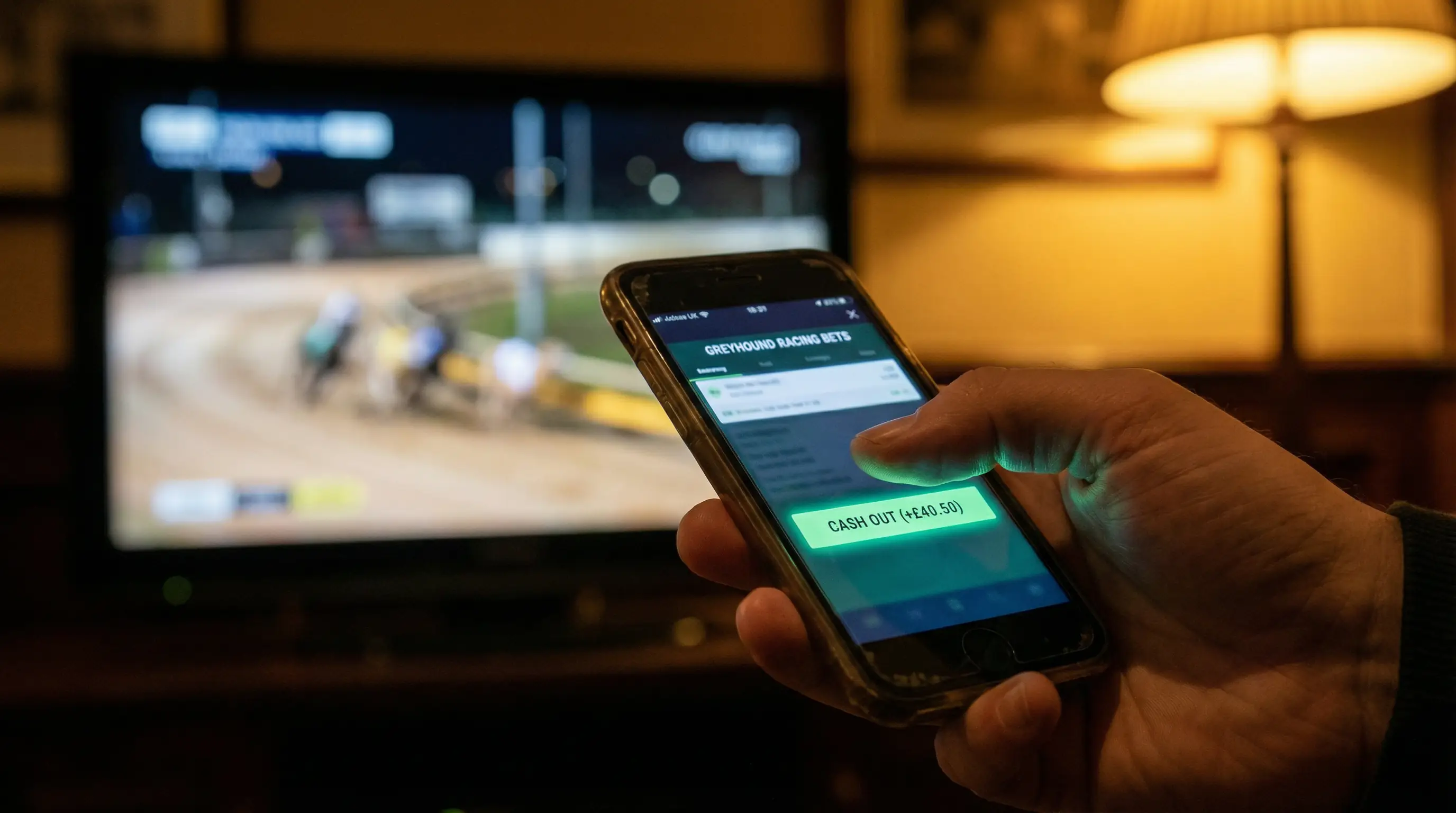
Cash Out Explained — Taking Profit Before the Finish Line
Your dog is leading into the final bend. Do you take the money or let it ride? That question, compressed into a split-second decision on a betting app, is the entire cash out experience in greyhound racing. The feature lets you settle a bet before the race finishes, locking in a return based on what’s happening right now rather than waiting for the final result.
Cash out has become one of the most prominently marketed features across UK betting apps, and its appeal is easy to understand. It offers control. Instead of being a passive spectator once your bet is placed, you become an active participant who can choose when to close the position. If your dog is leading midway through the race, the app will offer you a cash out value — less than the full winning payout, but guaranteed. If your dog is trailing, the offer drops, sometimes to zero. The feature transforms a binary outcome — win or lose — into a sliding scale where you can exit at various points along the way.
The psychology is seductive. The maths is more complicated. And for greyhound bettors, where races are short and volatility is extreme, understanding how cash out actually works — rather than how it feels — is essential before you start pressing that button. For an overview of greyhound bet types and mechanics, see the Timeform bet types guide.
How Cash Out Works on Greyhound Betting Apps
The app calculates a live offer based on current odds and your original stake. The cash out value at any given moment is not a random number or a generous gesture from the bookmaker. It’s a mathematical product of your original bet, the current probability of that bet winning, and a margin that the bookmaker retains.
Here’s the simplified calculation. You place a £10 bet on a greyhound at 5/1. Your potential return is £60 (£50 profit plus £10 stake). Before the race, if the dog’s odds shorten to 3/1, the implied probability of it winning has increased. The cash out offer will rise — perhaps to £15 or £18, reflecting the improved chance of the bet landing. If the odds drift to 8/1, the implied probability drops, and the cash out offer falls — perhaps to £5 or £6, below your original stake.
During the race itself, the calculation accelerates. As the dogs run and positions become clearer, the in-play odds move rapidly. A dog leading into the final straight might see its in-play odds compress to 1/5 or shorter, which pushes the cash out offer close to — but never quite equal to — the full payout. A dog that’s fallen to last will see its in-play odds explode to 25/1 or higher, and the cash out offer collapses accordingly.
The critical detail is the margin. The cash out offer is always less than the mathematically fair value of your bet at that moment. The bookmaker takes a cut — typically 3% to 5% of the theoretical value, though this varies by operator and isn’t disclosed transparently. This means that every time you cash out, you’re accepting a price that’s slightly below what your bet is actually worth based on the current odds. Over a single bet, that margin is small. Over hundreds of cash out decisions across a season, it compounds into a meaningful cost.
Some apps also offer partial cash out, which lets you settle a portion of your bet while leaving the remainder active. If you have a £10 bet and the cash out offer is £35, you might choose to cash out £20 and let the remaining portion ride. If the dog wins, you collect the proportional share of the full payout on the uncashed portion plus your £20. If it loses, you keep the £20 and lose the rest. Partial cash out is a more nuanced tool than full cash out, but the margin still applies to the portion you settle.
Which Apps Offer Cash Out on Dog Racing
Cash out availability, speed, and partial cash out options vary widely. Not every UK betting app treats greyhound cash out identically, and the differences in implementation can affect how usable the feature actually is in the context of a 30-second race.
Bet365 offers cash out on greyhound racing across both pre-race and in-play markets. Their implementation is one of the more responsive in the industry — the cash out offer updates frequently, and the confirmation process is relatively quick. They also offer partial cash out on greyhound bets, which gives more flexibility in managing positions. The main caveat is that in-play cash out on greyhounds requires a live stream or data connection fast enough to keep pace with the odds, and the window for in-play cash out is extremely narrow given the race duration.
Coral provides cash out on greyhound bets with a clear interface that displays the current offer prominently on the bet slip. Their system handles pre-race cash out smoothly, though in-play cash out on greyhound races can be hit-or-miss due to the speed at which odds change. Partial cash out is available on selected markets.
William Hill offers cash out on greyhound markets, including an auto cash out feature that lets you set a target cash out value in advance. If the cash out offer reaches your target, the app settles the bet automatically without requiring you to be watching the race. For greyhound bettors who want to lock in a specific profit level without monitoring every second of the race, this is a genuinely useful feature — though it still carries the bookmaker’s margin on the settlement.
Betfred and Ladbrokes both offer cash out on greyhound bets, with standard implementations that cover pre-race markets reliably. In-play cash out functionality exists but is more limited, with both apps occasionally suspending cash out during the most volatile moments of a race — precisely the moments when you’re most likely to want to use it. This isn’t a bug; it’s a risk management decision by the bookmaker, and it’s worth being aware of because the cash out button being greyed out when your dog hits the front is a frustrating but common experience.
Across all platforms, one universal truth applies: cash out on greyhound racing works best as a pre-race tool. Using it before the traps open — when odds are moving but the race hasn’t started — gives you a calmer decision-making environment and more time to weigh the offer. Using it in-play, during a race that lasts less than half a minute, is technically possible but practically challenging. The speed of the race, the latency of the app, and the bookmaker’s tendency to suspend cash out during rapid price movements all conspire to make in-play cash out unreliable as a consistent strategy.
When to Cash Out — and When to Hold
Cash out is a tool, not a panic button. The decision to cash out should be governed by the same analytical framework you used to place the bet in the first place — not by anxiety, excitement, or a gut feeling while watching the race unfold.
There are legitimate strategic reasons to cash out on a greyhound bet. The most defensible is when new information materially changes the probability of your bet winning. If you backed a dog pre-race based on its form and trap draw, but you then see in the parade that the dog is visibly unsettled or the track conditions have changed significantly — heavy rain, a rail change — the underlying analysis that justified your bet has shifted. Cashing out at a reduced value might be the rational move because the bet you placed is no longer the bet you intended.
Another reasonable cash out scenario is when you’re building a multi-bet position across a meeting and one strong result early in the card means you’ve already exceeded your profit target for the session. Taking cash on a later bet to lock in the session’s gains is a bankroll management decision, not a fear-based one. You’re not cashing out because you doubt the selection — you’re cashing out because the marginal value of the potential win is less than the cost of the potential loss to your session target.
Where cash out becomes destructive is when it’s used habitually. The bettor who cashes out on every winning position “to be safe” is systematically selling their winning bets below fair value. Remember the bookmaker’s built-in margin on every cash out offer. If you cash out your winners but let your losers run to the finish, you’re trimming the wins and preserving the losses — exactly the opposite of sound betting practice.
The same destructive pattern appears with loss-minimisation cash out. A dog is trailing badly, the cash out offer has dropped to £2 on a £10 bet, and the bettor takes the £2 rather than accepting the loss. Psychologically, it feels like salvaging something. Mathematically, it’s almost always wrong. The £2 offer means the bookmaker’s model estimates your dog’s winning probability at roughly 3%. If you believe the probability is genuinely 3% or lower, the cash out makes sense. But most bettors in that situation aren’t calculating probabilities — they’re reacting to the discomfort of losing, and that reaction costs them the occasional big-odds comeback that the full bet would have captured.
The clearest rule is this: don’t cash out on selections you still believe in at prices that are worse than fair value. If your analysis was sound and nothing has changed, let the bet run. Cash out when the information has changed, not when your nerves have.
The Cash Out Habit — Helping or Hurting?
Over time, habitual cash out usually costs more than it saves. This isn’t speculation — it follows directly from the margin structure. Every cash out settlement gives the bookmaker an additional edge. Used occasionally and strategically, that cost is small and justifiable. Used reflexively on a majority of bets, it erodes returns in a way that’s invisible per bet but significant over the course of a season.
The appeal of cash out is emotional rather than mathematical. It provides a sense of control in a sport where control is an illusion. The dogs don’t care about your bet. The traps open, 30 seconds later the race is over, and no amount of button-pressing changes the outcome. What cash out changes is how you experience that outcome — and that psychological comfort comes at a financial price.
The bettors who use cash out most effectively tend to use it least often. They place their bets based on pre-race analysis, they watch the race, and they accept the result. Cash out enters their process only when specific, predefined conditions are met — conditions they’ve identified before the race, not during it. Everyone else is paying a premium for the feeling of being in charge, and in a sport where margins are already thin, that premium is one most punters can’t afford.
