Each-Way Betting on Greyhounds
Best Greyhound Betting Sites – Bet on Greyhounds in 2026
Loading...
Each-Way Betting on Greyhounds — The Split-Stake Explained
Two bets in one — and the maths is simpler than you think. Each-way is one of the most commonly placed bet types in UK greyhound racing, yet a surprising number of punters who tick that box on the betslip don’t fully understand what they’re paying for. At its core, an each-way bet splits your stake into two separate wagers: one on your selected greyhound to win the race outright, and one on the same dog to finish in a place position. In greyhound racing, that means first or second.
The appeal is obvious. You don’t need your dog to cross the line first to see a return. If it finishes second, the place portion of your bet pays out at a fraction of the win odds — typically one quarter in dog racing. That safety margin makes each-way attractive to bettors who fancy a dog but aren’t fully confident it’ll take the race. It also makes it a genuinely useful tool when the odds are right and the race conditions favour a particular type of selection.
But here’s the part that gets overlooked: each-way doubles your total stake. A £5 each-way bet costs £10. If you don’t account for that, you can end up “winning” a place bet and still losing money overall. Understanding when each-way offers real value — and when it’s just a more expensive way to back a dog — is the difference between using it as a strategic instrument and treating it as a comfort blanket.
This guide breaks down the mechanics, the maths, the situations where each-way makes genuine sense, and the ones where a straight win bet is the smarter move. If you’ve ever ticked that E/W checkbox without thinking it through, this is where that changes.
How Each-Way Works in a Six-Dog Race
Your stake is split: half on the win, half on the place. That’s the entire structure of an each-way bet, and once you understand the payout mechanics, everything else follows logically.
Greyhound racing in the UK operates with six-dog fields. Under standard each-way terms, bookmakers pay two places — first and second. The place part of your bet is settled at one quarter of the win odds. These terms are essentially universal across licensed UK bookmakers, whether you’re betting on a Tuesday afternoon BAGS meeting or a Saturday evening feature card.
Let’s work through a concrete example. You back Trap 4 at 8/1 each-way with a £5 unit stake. Your total outlay is £10 — £5 on the win, £5 on the place.
If Trap 4 wins, both parts of the bet pay out. The win portion returns £5 at 8/1, which is £40 profit plus your £5 stake back. The place portion returns £5 at one quarter of 8/1 — that’s 2/1 — giving you £10 profit plus your £5 stake. Total return: £60. Total profit: £50.
If Trap 4 finishes second, only the place portion pays. You lose the £5 win stake entirely. The place part returns £5 at 2/1, giving you £10 profit plus your £5 stake back — a total return of £15. Since you staked £10 in total, your net profit is £5. A positive outcome, but notice how thin the margin is. At shorter odds, the place return might not even cover your total stake.
If Trap 4 finishes third or worse, both parts lose. You’re down £10.
This is the critical threshold that most bettors don’t calculate in advance: the minimum odds at which an each-way bet breaks even on a place-only result. In a six-dog race paying one quarter odds for two places, the break-even point is 4/1. At 4/1 each-way, a place finish returns your exact total stake and nothing more. Below 4/1, a place result actually loses you money. At 3/1 each-way, for instance, the place part pays at 3/4 — a £5 place bet returns £8.75, but your total stake was £10. You’ve “placed” and still lost £1.25.
That arithmetic changes the way you should think about each-way entirely. It’s not a hedge. It’s a bet with a built-in threshold, and if you’re operating below that threshold, you’re paying for insurance that doesn’t cover the cost.
For greyhound betting, the practical rule is simple: each-way starts making mathematical sense at 5/1 and becomes genuinely attractive at 6/1 and above. Below 5/1, you’re almost always better off with a straight win bet at a larger unit stake or a place-only bet if your bookmaker offers it.
When Each-Way Makes Sense — and When It Doesn’t
Short-priced favourites? Skip each-way. Outsiders at 6/1 or bigger? Now we’re talking. But odds alone don’t tell the whole story. The race shape, the dog’s profile, and the likely pace scenario all factor into whether each-way represents genuine value or a waste of half your stake.
Each-way works best when you’ve identified a greyhound with a realistic chance of hitting the frame but whose win claims are uncertain. The classic scenario is a strong finisher drawn wide — Trap 5 or Trap 6 at a track with tight early bends. This type of runner often gets crowded out in the first 100 metres but comes through late to claim second. It won’t win many races from that position, but it places consistently. At 7/1 or 8/1, the each-way return on a place finish alone is worthwhile.
Another good spot is when a graded race has one clearly dominant dog at short odds — say 4/6 or even shorter — and the rest of the field is priced between 5/1 and 12/1. In that scenario, the favourite is likely to win, but the battle for second is wide open. Each-way on one of the mid-priced runners gives you a realistic target: the place behind the banker. You’re not fighting the favourite; you’re fighting the other outsiders.
Races with evenly matched fields are a different proposition. When three or four dogs are priced between 2/1 and 4/1, each-way becomes poor value because the odds are too compressed. The place return at those prices won’t cover your doubled stake. In tightly priced fields, a straight win bet or a forecast is nearly always the better use of your money.
The same logic applies to short-priced favourites. Backing a 6/4 shot each-way is mathematically indefensible unless you believe the dog has no chance of winning but a decent chance of placing — which raises the question of why you’re backing it at all. At 6/4, the place part pays at roughly 1.5/4 (that’s 3/8), returning less than your total stake. You’d need the win to land for the bet to show any profit, at which point you might as well have just backed it to win at better returns per pound risked.
There’s also a situational angle worth noting: trap draws and track geometry. At tracks like Romford, where the inside traps have a measurable advantage, a mid-priced railer drawn in Trap 1 or 2 might have a bigger place probability than its odds suggest. Each-way can extract value from that discrepancy. At fairer tracks like Nottingham, where trap bias is less pronounced, the form matters more than the box and each-way decisions should lean more heavily on the dog’s recent finishing positions.
The bottom line is that each-way is a conditional tool. It performs well in specific circumstances — long-priced selections, strong place candidates, lopsided field structures — and performs poorly in compressed markets and on short-priced dogs. Knowing the difference before you place the bet is the entire skill.
How to Place an Each-Way Bet on a Greyhound App
One checkbox changes everything on the betslip. The process of placing an each-way bet through a greyhound betting app is mechanically identical to placing a win bet — with one small but expensive addition that you need to understand before you tap confirm.
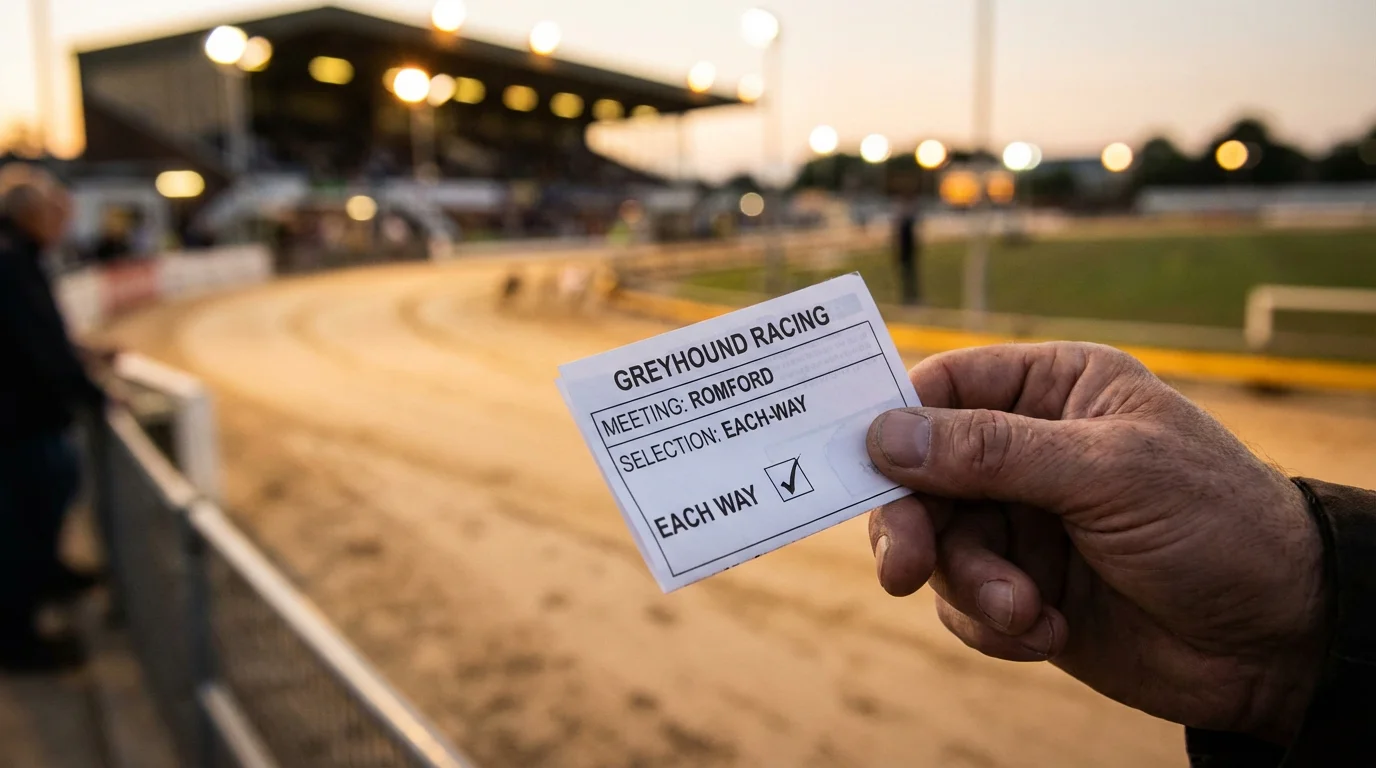
Open the greyhound racing section of your app and navigate to the meeting you want to bet on. Select the race and tap the odds next to the dog you want to back. This adds the selection to your betslip, and by default it will be set up as a win bet. Somewhere on that betslip — usually directly below the stake input field — you’ll see a toggle or checkbox labelled “E/W” or “Each Way.” Activate it.
The moment you tick that box, pay attention to the total stake displayed. If you type £5 into the stake field with each-way selected, the app will show your total stake as £10. This is £5 on the win and £5 on the place. Some apps display this clearly with a breakdown; others simply double the number without much explanation. If you’re on a budget, remember that the figure you type is the unit stake, not the total outlay.
Most major UK betting apps — Bet365, William Hill, Coral, Ladbrokes, Betfred — display the each-way terms alongside the selection. For greyhound racing, these terms will almost always read “1/4 odds, 2 places.” That tells you exactly what fraction of the win odds the place part will pay and how many finishing positions qualify. There’s no ambiguity and no variation between bookmakers on standard greyhound races.
One thing to watch: some apps also offer a “place only” option as a separate market, which is a different bet entirely. Place only means you’re backing the dog to finish first or second with a single stake, and the odds are set independently — they’re not derived from the win price. Each-way and place betting are not the same thing, and confusing the two on the betslip is a mistake worth avoiding.
Before confirming, do the quick mental check: are the odds above 4/1? If yes, a place result returns more than your total stake. If no, reconsider. That three-second calculation is the difference between a thoughtful each-way bet and a reflexive one.
Each-Way as a Risk Tool, Not a Safety Net
Used correctly, each-way is precision. Used blindly, it’s just a more expensive way to lose. That distinction matters because the way most bettors interact with each-way is exactly backwards — they treat it as insurance against a losing bet rather than as a deliberate strategy for extracting place value from certain types of races.
The punters who use each-way well tend to share a few habits. They identify dogs with strong place profiles: consistent runners who finish in the first two regularly but rarely dominate. They check the odds threshold before they bet, confirming that the price makes the place portion worthwhile on its own merit. And they treat the win part of the bet as the bonus rather than the expectation. When the dog places, they’re content with the return. When it wins, the double payout is a windfall, not the plan.
This framing matters for bankroll management too. Because each-way doubles your outlay per selection, it should be factored into your staking plan explicitly. If your standard unit is £5 on a win bet, your each-way unit needs to be £2.50 to maintain the same total exposure. Bettors who keep their win stake and add each-way on top are effectively doubling their risk on that race without necessarily doubling their edge.
There’s a temptation, particularly in greyhound racing where the action is fast and the meetings are frequent, to default to each-way on every selection. Resist it. Each-way should be the exception in your betting approach, reserved for selections where the race conditions, the odds, and the dog’s profile all align to make the place component independently valuable. Everywhere else, a clean win bet — or no bet at all — is the sharper choice.
The E/W checkbox is a tool. Like every tool, its usefulness depends entirely on whether you know when to pick it up and when to leave it in the drawer.