UK Greyhound Racing Tracks — Distances, Stats & Track Guides
Best Greyhound Betting Sites – Bet on Greyhounds in 2026
Loading...
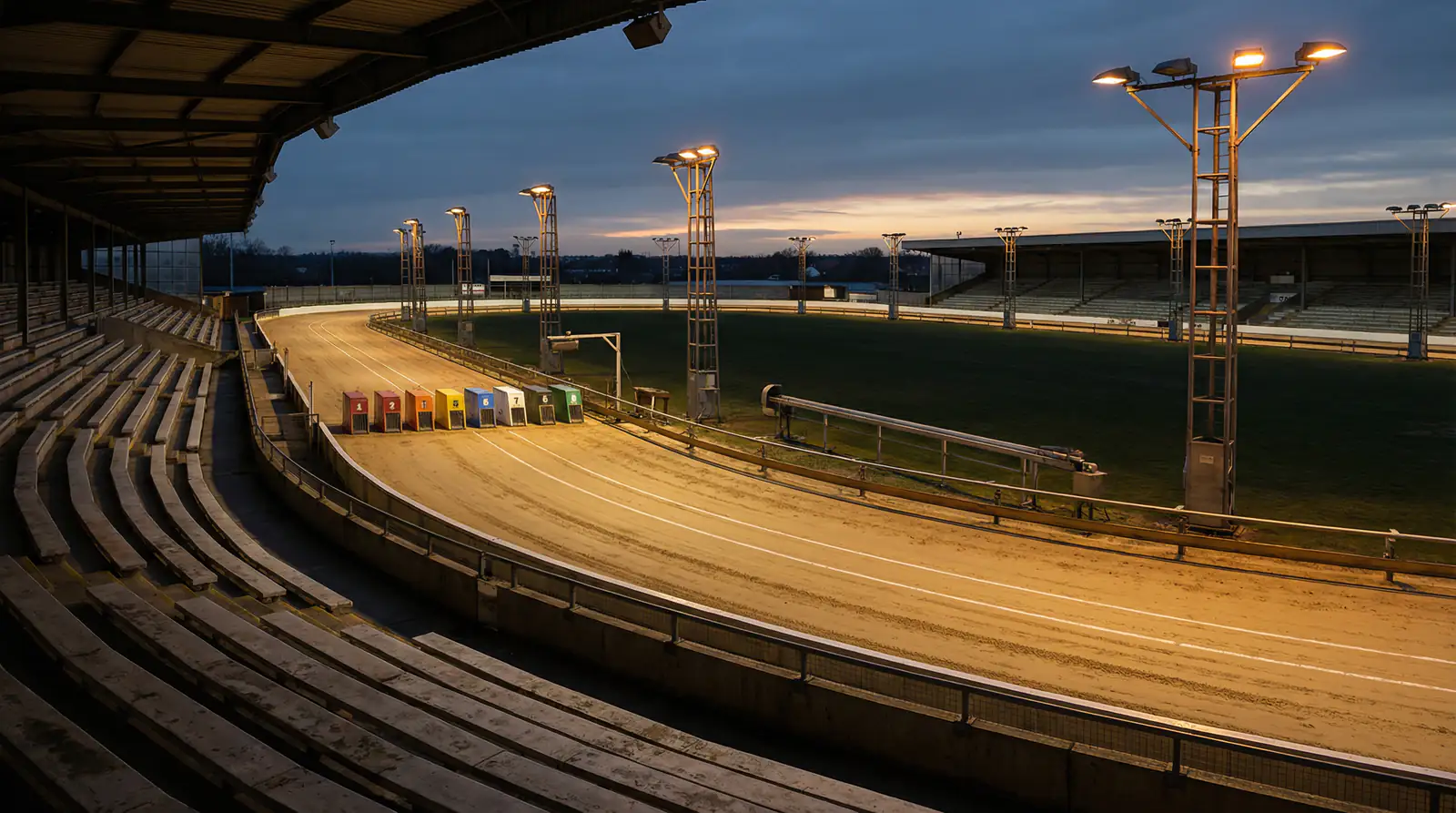
Every Track Has a Personality — Learn It Before You Bet
Backing a dog without knowing the track is like betting on a footballer without knowing the pitch. The form figures tell you how the dog has been running. The track tells you whether those performances are relevant to the race in front of you.
UK greyhound tracks are not interchangeable. Each has a distinct circumference, a specific distance from the traps to the first bend, a particular bend radius, and a sand surface that behaves differently depending on maintenance, weather, and traffic patterns. A dog that dominates at Romford — with its tight bends and short run-up — may struggle at Nottingham, where the wider circuit rewards a different running style. A sprinter that excels at Monmore over 264 metres might find no sprint races available at a venue that only offers middle-distance and staying events.
For bettors, track knowledge is the contextual frame that gives form data its meaning. A race time, a grade, a trap draw — all of these are track-specific. Comparing them across venues without understanding the differences between those venues produces misleading conclusions. This guide profiles the GBGB-licensed circuit, details the major tracks that carry the most form data and host the biggest events, explains how distances and surface conditions affect performance, and shows you how to use track bias data in your betting analysis.
The track is not background. It is your first variable.
GBGB-Licensed Tracks — The Full UK Circuit
The Greyhound Board of Great Britain (GBGB) regulates licensed greyhound racing in the UK. GBGB-licensed tracks operate under a consistent set of rules covering animal welfare, race integrity, and competitive standards. Racing at these venues is the only form of greyhound competition that feeds into official form records, starting prices, and the data infrastructure that betting apps and form services rely on.
The circuit currently comprises tracks spread across England, with venues in London, the Midlands, the North, and the South. The roster has contracted over the decades — tracks like Wimbledon, Hall Green, and most recently Crayford (which closed permanently in January 2025) have been lost to redevelopment and shifting economics. The tracks that remain represent the active core of British greyhound racing, and each contributes to the daily fixture list that fills BAGS afternoon cards and evening meetings.
Not all tracks carry equal weight for bettors. The busier venues — Romford, Nottingham, Monmore, Sheffield, Towcester — host more meetings, attract larger pools of dogs, and generate deeper form libraries. The more data a track produces, the more reliable your analysis can be. Smaller tracks with fewer meetings produce thinner form records, which means less statistical confidence in trap biases, time comparisons, and grade assessments. This does not make smaller venues unprofitable to bet on, but it does mean your analysis at those tracks relies more on individual dog form and less on historical track patterns.
Each GBGB track offers racing over multiple distances, though the specific distances available vary by venue. A track’s distance menu is determined by its physical layout — the circumference of the oval, the position of the starting boxes, and where the finish line sits relative to the bends. This means that a “standard” race at one track might be 460 metres while the equivalent at another is 480 metres. Those twenty metres matter. They change the race dynamic, the time benchmarks, and the type of dog that thrives.
When you open a racecard on your betting app, the track name and distance are printed at the top of every race. Treat them as the first two things you read, not the last. They set the context for everything that follows.
Major UK Greyhound Tracks — Detailed Profiles
The tracks that host the biggest races and carry the most form data are the ones every regular greyhound bettor should know intimately. These are the venues that appear most frequently on the BAGS schedule, attract the strongest fields for feature events, and produce the deepest statistical records for trap bias and time analysis. What follows is a profile of five major UK tracks — not an exhaustive catalogue of every venue, but a detailed look at the circuits that shape the majority of greyhound betting activity.
Romford — Fast, Tight and Trap-Dependent
Romford is one of the busiest greyhound tracks in the UK, running multiple meetings per week and featuring prominently on the BAGS schedule. The track is a tight oval with a short run from the traps to the first bend, and that geometry makes trap draw more consequential here than at almost any other UK venue. Inside traps — particularly Trap 1 and Trap 2 — historically outperform the statistical average in sprint races, because the short run-up gives inside-drawn dogs an immediate advantage in reaching the rail before the first turn.
The standard distances at Romford include sprints, middle-distance events, and longer trips. Sprint racing here is where the trap bias is most pronounced. Middle-distance races show a more balanced distribution, though the inside still tends to outperform slightly. The track surface is typical UK sand, and wet conditions can affect times significantly — Romford’s compact layout means that rain affects the bends disproportionately, because the tighter turns demand more traction.
For bettors, Romford is a track where trap analysis is non-negotiable. Backing a dog at this venue without checking the trap statistics for the relevant distance is ignoring the most predictive variable available. The form data is deep — the high frequency of meetings means dogs build long records at the venue — and the race grading system covers a wide range from maiden events to competitive opens.
Nottingham — Fair Galloping Track
Nottingham is widely regarded as one of the fairest tracks in UK greyhound racing. The circuit is larger than Romford’s, with a longer run to the first bend and wider turns that reduce the geometric advantage of inside-drawn dogs. The result is a more balanced trap distribution, where form and ability matter more relative to starting position than at tighter venues.
The track hosts regular meetings including competitive graded cards and feature events. The distances available span the standard range, and the longer straights suit dogs with sustained pace rather than pure early speed. Dogs that struggle on tight-turning tracks sometimes improve at Nottingham, where the wider circuit gives them room to run without being squeezed on the bends.
For bettors, Nottingham is a track where form reading carries more weight than trap analysis. The balanced geometry means no trap enjoys a persistent statistical advantage, so your focus shifts to the dogs themselves — their recent performances, their grade trajectory, their response to the going. It is a venue that rewards thorough form study and tends to produce results that align with the market more consistently than tracks with pronounced biases.
Towcester — Home of the Greyhound Derby
Towcester is a dual-purpose venue hosting both horse racing and greyhound racing, and it is home to the English Greyhound Derby — the most prestigious event in the British greyhound calendar. The greyhound track is a modern circuit with a galloping layout that produces some of the fastest middle-distance times in the UK. The longer straights and sweeping bends favour dogs with sustained speed rather than those that rely on inside-rail advantages.
The track’s association with the Derby gives it a significance in the sport that extends beyond its regular fixture list. The best dogs in the country compete at Towcester during the Derby campaign, and the form produced at the venue during these events is among the highest-quality data in UK greyhound racing. Outside the major competitions, Towcester runs standard graded meetings that feed into the regular BAGS schedule.
From a betting perspective, Towcester’s wider geometry means trap draw is less decisive than at compact tracks. The longer run to the first bend gives all six dogs time to settle into stride, which reduces the crowding and interference that plague tighter circuits. Dogs with strong overall pace — rather than just fast breaks — tend to perform well here. When a dog transfers to Towcester from a tighter track, its previous trap-draw history matters less than its raw ability and stamina profile.
Monmore — Sprint Specialist’s Playground
Monmore Green in Wolverhampton is one of the UK’s most popular sprint-racing venues. The track offers a short sprint distance that attracts dogs with explosive early pace, and the compact layout — while not as tight as Romford — still produces a measurable inside-trap bias in the shorter races. Over middle distances, the advantage narrows, and the track rewards a broader range of running styles.
Monmore runs a busy schedule with regular evening meetings and BAGS fixtures. The grading structure covers the full range, and the volume of racing generates a deep form library for analysis. Sprint events at Monmore are particularly data-rich, with enough historical results to build reliable trap statistics at the specific sprint distance.
For bettors, Monmore is a specialist venue. If you focus on sprint racing, the trap and early-pace data at this track is among the most actionable in UK greyhound racing. Middle-distance events at Monmore are more conventional — form and class carry the usual weight. The distinction between the two race types at the same venue illustrates why distance-level analysis matters: the same track can demand entirely different betting approaches depending on the trip.
Sheffield Owlerton — One of Britain’s Oldest Tracks
Sheffield Owlerton is one of the longest-established greyhound venues in the country. The track has hosted racing for decades and retains a loyal local following alongside its regular contribution to the national fixture list. The circuit is medium-sized, with a geometry that sits between the tight compactness of Romford and the open galloping character of Towcester.
The track offers standard and middle-distance races, with the form data reflecting a consistent pool of locally trained dogs supplemented by open-class visitors for feature events. Sheffield’s surface and bend characteristics produce its own trap patterns — neither as pronounced as Romford’s inside bias nor as neutral as Nottingham’s balanced distribution. Checking recent trap data at this venue rewards the effort, particularly over the standard distance where the majority of races are contested.
For bettors, Sheffield represents a mid-tier UK track with enough racing volume to support meaningful form analysis. The key is treating it on its own terms — not assuming that trap biases from other venues apply, and not comparing times against different circuits. Like every GBGB track, Sheffield has its own personality. Learning it is part of the job.
Standard Distances and Race Types Across UK Tracks
Sprint, standard, stayers, marathon — every distance category tells you something different about the dogs that run in it and the betting dynamics you can expect.
Sprint races cover distances under approximately 300 metres. They are short, explosive contests where trap speed is paramount. The race is often decided in the first three seconds: the dog that breaks fastest and reaches the bend in front wins more often than not, because there is simply no time for slower starters to make up ground. Sprint fields tend to be dominated by dogs with proven early pace, and the form is often more predictable than at longer distances — which also means the dividends on forecasts and tricasts are typically lower.
Standard middle-distance races — roughly 380 to 550 metres — are the backbone of UK greyhound racing. The majority of races on any given card fall into this category, and the standard distance is where the deepest form data exists. Middle-distance racing tests a broader range of attributes than sprinting: trap speed still matters, but stamina, bend technique, and the ability to recover from a poor break all play a role. The balance between early pace and closing speed makes middle-distance races the most analytically rich category for bettors.
Staying races cover distances between approximately 600 and 700 metres. They test endurance as much as speed, and the field dynamics shift accordingly. Dogs that lack early pace but sustain their speed over a longer distance often find their niche in stayers’ events. The form is thinner — fewer staying races are run, so dogs accumulate shorter records at these distances — and the fields can be less competitive, which affects forecast and tricast dividend potential.
Marathon races exceed 800 metres and are offered at only a handful of UK tracks. They are a specialist category with small fields and limited form, making them both challenging and potentially rewarding for bettors willing to do the homework. The scarcity of marathon form data means the market is often less efficient — prices are set with less confidence, and opportunities for value are more frequent than in the heavily analysed middle-distance category.
Understanding which distance category a race belongs to — and what that implies about the type of dog that wins — is the first step in assessing any racecard. A dog’s form at 480 metres does not automatically translate to 640 metres. Distance is not just a number; it is a filter that determines which attributes matter most.
Sand Tracks and Track Conditions — What Affects Performance
Wet sand slows dogs differently — and some thrive in it. Every licensed UK greyhound track runs on a sand surface, but the word “sand” conceals meaningful variation. The composition of the sand, the depth of the layer, the drainage system beneath it, and the frequency and method of maintenance all differ between venues. These factors determine how the track behaves in different weather conditions, and that behaviour directly affects race times and finishing orders.
The going report on the racecard — typically described as normal, slow, or fast — is the official summary of track conditions at the time of racing. Normal going represents the baseline: the surface is in its standard state, and published times are directly comparable to historical averages. Fast going usually results from dry conditions compacting the sand, producing quicker times and favouring dogs with high peak speed. Slow going, caused by rain or heavy watering, softens the surface, increases race times, and demands more physical effort from the runners.
The impact on betting is practical. On slow going, front-runners that rely on early pace may struggle to maintain their advantage, because the softer surface saps energy faster. Closers and stayers sometimes find slow going suits them — the pace-setters tire earlier, and the longer-striding dogs have more time to make up ground. Conversely, fast going amplifies early speed, making trap draw and break speed even more important than usual. A dog that is already quick from the boxes becomes harder to catch when the surface is running fast.
Track maintenance — harrowing between races, watering to control dust and consistency — also affects the surface within a single meeting. The going can change between the first and last race of an evening card, particularly if rain arrives mid-meeting or if the track dries out under stadium lights. Watching the early races on a card, either through live streaming or results, gives you a real-time read on how the surface is performing compared to what the official going description suggested. If the first three races produce times significantly slower than the standard for that distance and going, the surface is playing differently than expected — and your analysis for later races should adjust accordingly.
Track Bias Data and How to Use It
Some tracks favour inside runners. Others reward pace. The data does not lie — but it does demand careful interpretation. Track bias is the measurable tendency of a venue to produce outcomes that favour certain trap positions, running styles, or pace profiles more than random chance would predict. It exists at every UK greyhound track, though the strength and nature of the bias varies by venue, distance, and conditions.
The most common form of track bias is trap bias: a persistent advantage for inside or outside traps at a specific distance. This has been covered in the individual track profiles above, but the practical question is how to incorporate it into your betting workflow. The answer is not to back every dog drawn in the favoured trap, which would be crude and unprofitable. The answer is to use trap bias as a weighting factor within your broader analysis.
Consider a scenario where your form analysis has narrowed a race to two contenders. Dog A has slightly better recent form but is drawn in a statistically weak trap at this venue. Dog B has marginally inferior form but is drawn in the most productive trap. Without bias data, Dog A is the selection. With bias data, the picture shifts — Dog B has a structural advantage that partially compensates for the form gap. In tight races, this kind of calibration makes the difference between backing a winner and backing a loser. Over hundreds of bets, it is the difference between a losing record and a break-even one.
Pace bias is subtler but equally useful. Some tracks — particularly tight-turning ones with short runs to the first bend — disproportionately reward early speed. The dog that leads at the first bend wins the race more often than expected, because the tight geometry makes it difficult for dogs behind to find running room. At these venues, dogs with strong early sectionals have a compounding advantage: the bias favours leaders, and their pace makes them more likely to lead. Other tracks, with longer straights and more gradual bends, are more forgiving of slow breaks. Closers win at a rate closer to what their form suggests, and the pace bias is weaker.
Going-related bias adds another layer. A track that favours inside runners on normal going might produce a more balanced trap distribution on slow going, because the softer surface reduces the speed advantage of the shorter inside path. Monitoring how bias shifts with going conditions requires either a dedicated data service or your own records. Keeping a simple log — date, track, distance, going, winning trap — across meetings you follow regularly is enough to spot patterns over a few weeks.
The practical tools for accessing bias data are the same ones used for trap statistics: Timeform, specialist greyhound data sites, and the race results archive on the GBGB website. Some bettors maintain spreadsheets. Others rely on third-party summaries. The method matters less than the consistency of checking before you bet. Bias data is not a prediction system. It is a lens that sharpens the picture your form analysis has already drawn.
The Track Isn’t Background — It’s Your First Variable
Know the track, know the traps, then — and only then — look at the dogs.
That sequence sounds counterintuitive. Most bettors open the racecard, check the form figures, pick the dog that looks strongest, and place the bet without a second thought about the venue. But the venue is what gives the form figures their meaning. A form line of 111243 is impressive in isolation. If those three wins came at Nottingham over 500 metres and the dog is now running at Romford over 400 metres in a trap it has never won from, the form line tells you very little about tonight’s race.
The bettors who consistently find value in greyhound racing are the ones who build track-specific knowledge over time. They know that Romford sprints favour inside traps. They know that Nottingham produces fair results with less trap influence. They know that Towcester rewards sustained pace and that Monmore’s sprint programme is where early-speed specialists thrive. This knowledge is not arcane or inaccessible — it is publicly available, freely compiled by data services, and updated with every meeting. The only cost is the time to look it up and the discipline to factor it into every assessment.
Start with the tracks you bet on most frequently. Learn their distances, their trap records, their going patterns. Watch a full card when you can, noting how the track is running compared to what the data predicted. Over weeks and months, you build an instinctive feel for each venue that supplements the statistical framework — a sense for which dogs suit which tracks that goes beyond what numbers alone can convey. That combination of data and observation is the foundation of informed greyhound betting, and it begins with the track.