SP vs Early Price — When to Take Greyhound Odds & Why It Matters
Best Greyhound Betting Sites – Bet on Greyhounds in 2026
Loading...
The Timing Decision That Most Bettors Never Think About
When you place a greyhound bet matters almost as much as what you bet on. Every wager involves a timing decision — whether to take the price you see now or wait for the starting price. Most bettors don’t think about this as a decision at all. They open the app, see the odds, and bet. But the price at the moment you click is rarely the same price that the market settles on by the time the traps open, and that difference, accumulated over hundreds of bets, has a measurable effect on your long-term returns.
The choice between taking an early fixed price and betting at SP is one of the most practical strategic decisions in greyhound betting. It doesn’t require any additional form knowledge. It doesn’t change your selection. It changes the odds at which your selection is settled — and in a game where the margin between profit and loss is often a single point on the odds, that change matters.
How Starting Price Is Determined
The starting price in greyhound racing is the final price offered by the major bookmakers at the moment the traps open. Unlike horse racing, where the SP is historically determined by on-course bookmakers at the racecourse, greyhound racing has no on-course betting ring. The SP is derived from the off-course market — effectively a snapshot of the prices available from licensed bookmakers at race time. For a broader overview of greyhound betting mechanics, Timeform’s guide is a useful reference.
The SP represents the market’s final assessment of each dog’s chance. It incorporates all the money that has arrived since the market opened — early bets, late bets, informed money, public money — and settles at a point that reflects the aggregate opinion. In theory, the SP is the most informed single price available because it benefits from the full weight of market activity. In practice, that informational advantage is modest in greyhound racing because the market volume is lower than in horse racing, which means individual large bets can move the SP disproportionately.
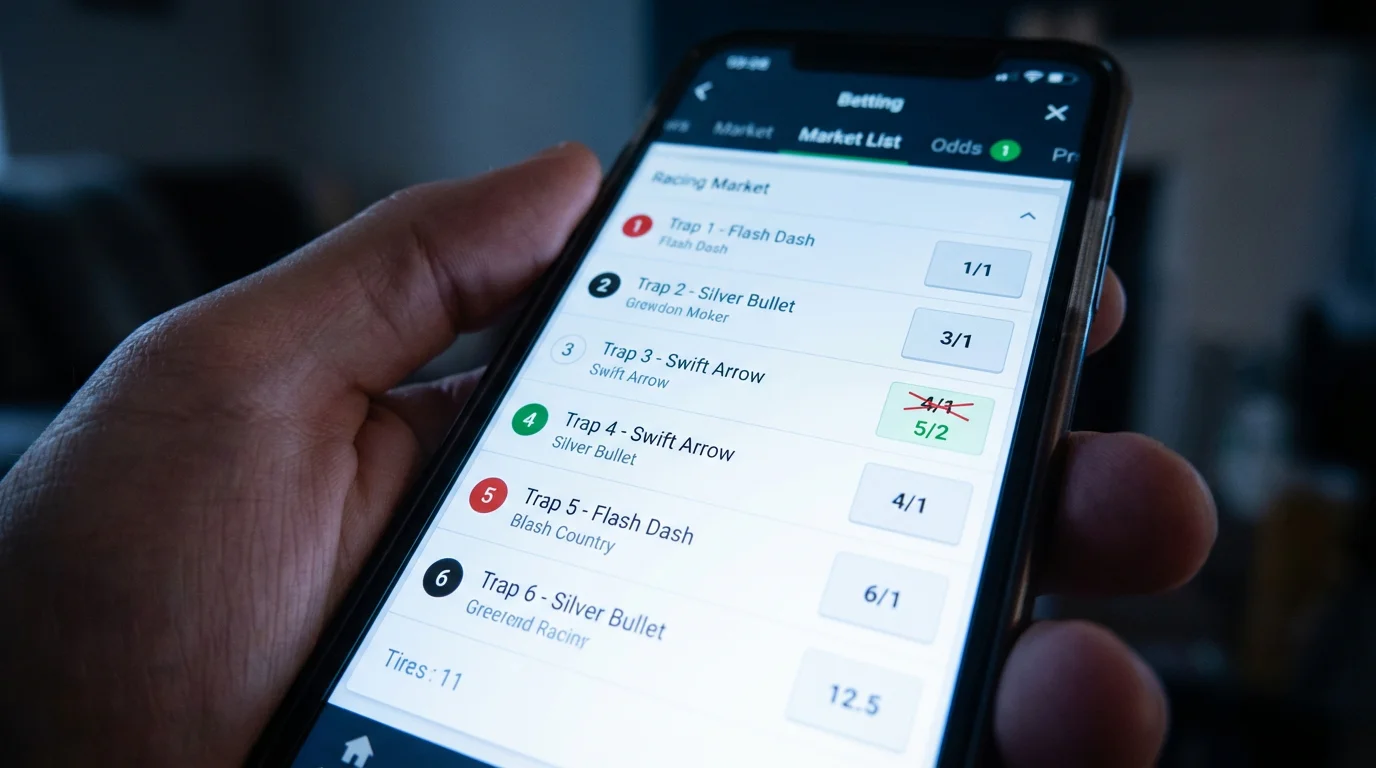
When you bet at SP, you’re accepting uncertainty. You don’t know your odds until after the race. If the dog you backed shortens from 5/1 to 3/1 before the off — because money came in for it — your SP bet is settled at 3/1. You’ve lost two points of value relative to the price that was available earlier. If the dog drifts from 5/1 to 7/1, your SP bet captures that drift. The direction of movement is unpredictable, which is precisely why the timing decision is strategic rather than trivial.
One characteristic of greyhound SP that differs from horse racing: the volatility window is compressed. Horse racing markets can be open for hours, with the SP forming gradually. Greyhound markets, particularly for afternoon BAGS meetings, often have prices available for only 30 to 60 minutes before the race. Evening meetings may have longer markets, but even then, the final significant movements happen in the last five to ten minutes. This compressed window means that the gap between early prices and SP can be proportionally larger in greyhound racing than in horse racing — the same amount of market activity is squeezed into a shorter timeframe.
Advantages of Taking Early Prices
The case for taking early prices in greyhound racing rests on one principle: if your selection analysis is correct, the price is most likely to shorten rather than drift. If you’ve identified a dog with a genuine chance that the market hasn’t fully recognised, the early price reflects that under-recognition. As other bettors arrive at the same conclusion, money flows onto the dog and the price shortens. By taking the early price, you’ve captured the value before the market corrected.
This principle isn’t always true — sometimes your selection drifts, meaning you would have been better off at SP. But across a large sample of bets, bettors who consistently identify value tend to find that their selections shorten more often than they drift. The academic term for this is “closing line value”: if the price you take is consistently better than the price available at the close of the market, your betting method is capturing value that the market subsequently confirms. In greyhound racing, the “close” is the SP.
Early prices are also particularly advantageous when Best Odds Guaranteed is active. With BOG, you take the early price and are guaranteed the higher of that price or the SP. This completely eliminates the downside of taking an early price — if you’re wrong about the direction of movement and the SP drifts higher, BOG upgrades your bet automatically. The combination of early price plus BOG is the optimal betting strategy for any race where the promotion applies, because it captures the upside of both timing scenarios with no penalty for either.
There’s a practical argument too. Early prices are available when you’re calm, focused, and studying the racecard methodically. If you wait until the final minutes before the race, you’re betting in a noisier environment — the stream is running, the market is moving, and the pressure to decide quickly can compromise your judgement. The price you take early may not be the best price that materialises, but the decision that led to it was made in the best analytical conditions.
Decision Framework: SP or Fixed
The choice doesn’t have to be all-or-nothing. Different race situations favour different approaches, and the disciplined bettor adapts the timing decision to the specific conditions of each race.
Take early prices when you have strong conviction in your selection, the current odds reflect a price you’re happy with, and BOG is available. In this scenario, the early price is either correct value or will be upgraded by BOG if the SP is higher. There’s no material advantage to waiting.
Consider SP when you’re unsure whether you want to bet at all and are waiting for late information to make the decision. If the dog’s behaviour in the parade, or a significant market move in the last few minutes, is likely to inform your choice, delaying until SP keeps your options open. The price you get may be worse, but the information that informs the bet is better.
The race profile matters. On high-profile evening cards where the market has been open for several hours and significant money has already been traded, the SP is likely to be well-informed and close to efficient. The gap between the early price and the SP will tend to be small, which means the timing decision has less impact. On lower-profile BAGS meetings where the market opens late and trades thinly, the early prices can be significantly out of line with the final SP — in either direction. These thinner markets offer the most potential benefit from early price-taking, but also the most uncertainty.
For dogs you’ve assessed as steamers — selections that the market will likely shorten once betting begins — taking the early price is nearly always correct. You’re capturing the price before the market corrects to what you believe is the true probability. For dogs you expect to drift — perhaps a popular name that the market will over-bet before more informed money arrives — SP may offer better value. But predicting drift is harder than predicting shortening, because drift often indicates that the informed market disagrees with your assessment, which should give you pause.
A simple rule of thumb: if you’d be annoyed to see your selection win at a shorter SP than the price currently available, take the price now. If you’re uncertain enough about the selection that you’d be relieved to see it drift, perhaps the bet itself needs more analysis rather than a timing adjustment.
Price Is a Bet in Itself
Every time you take a price, you’re implicitly betting that the price represents fair value or better. Every time you bet at SP, you’re implicitly accepting whatever the market decides. Neither is inherently right or wrong. The question is which approach, applied consistently over hundreds of bets, produces the better outcome for your specific method of selecting dogs.
Bettors whose selections tend to shorten should take early prices. Bettors whose selections tend to drift might benefit from SP. Most bettors have no idea which category they fall into, because they’ve never tracked it. If you’re serious about improving your greyhound betting returns, start recording the price you take and the eventual SP for every bet. After 100 bets, the pattern will be clear. If your prices are consistently better than the SP, your timing is working. If they’re consistently worse, you need to either bet earlier or reassess your selection method.
The timing decision is invisible — it doesn’t feel like a bet, because you’re not choosing a dog, you’re choosing a moment. But that moment determines the odds, and the odds determine the return. In a sport where the difference between profit and loss can be measured in fractions of a point per bet, choosing the right moment is choosing the right edge.