Greyhound Racing Weights
Best Greyhound Betting Sites – Bet on Greyhounds in 2026
Loading...
Greyhound Weight — A Data Point Most Bettors Ignore
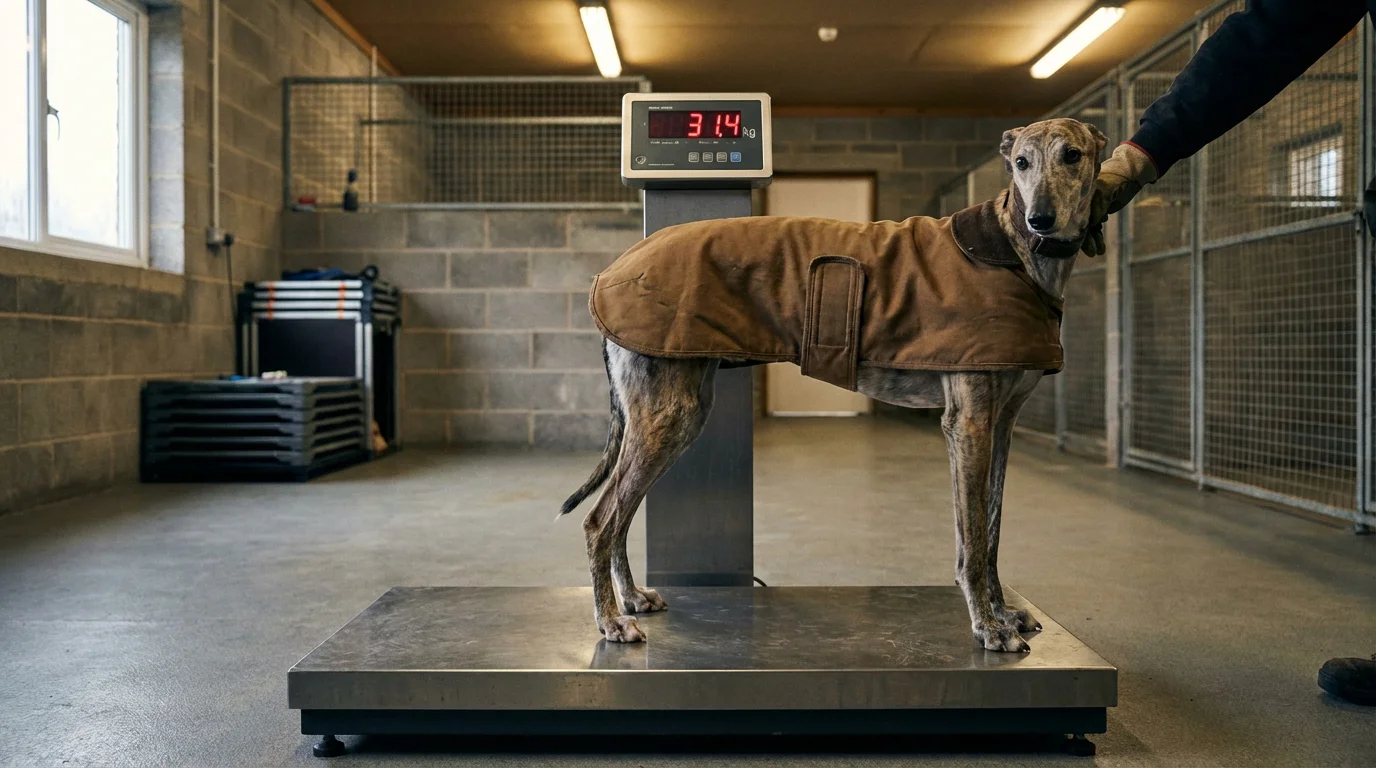
It’s on the racecard. Most people skip past it. Some shouldn’t. Every greyhound competing in a UK licensed race is weighed before the meeting, and that weight is published as part of the official racecard. It sits there alongside the dog’s form figures, trap draw, trainer name, and recent times — one more number in a row of numbers. Most bettors scroll past it without a second thought, their attention focused on more obviously impactful data like finishing positions and race times.
The question of whether greyhound weight matters for betting purposes is genuinely debatable. Unlike horse racing, where weight is a core handicapping tool — literally added to a horse’s back to equalise competition — greyhound racing doesn’t use weight as a competitive variable. No weight is carried. The dog runs at its natural body weight, and the variation between that weight at different stages of its career or condition cycle is the only relevance it has. There’s no weight allowance, no weight penalty, and no official view that a few hundred grams should change your assessment of a dog’s chance.
And yet. The weight is recorded for a reason. Trainers monitor it carefully. Racing managers note significant changes. Among experienced punters, a dog’s weight relative to its own history is treated as a fitness indicator — not a primary factor, but a background signal that occasionally reveals something the form figures don’t. Whether that signal is strong enough to influence your betting depends on understanding what the data actually shows and what it doesn’t.
Does Weight Actually Affect Greyhound Performance?
The data is mixed — but trends emerge at the extremes. The honest answer to whether weight affects greyhound racing performance is: probably, but not in the straightforward way most people assume. A heavier dog isn’t automatically slower, and a lighter dog isn’t automatically faster. The relationship between weight and speed is not linear, and the effect size — where it exists at all — is small relative to other factors like form, fitness, and the trap draw.
What research and observation suggest is that each greyhound has an optimal racing weight — a range within which it performs best. That range is individual to the dog and is typically established over its first few dozen races. A dog that consistently runs its best times at 32kg is, in practical terms, at its optimal weight when it races at or near that figure. Deviations from that optimal range — either up or down — correlate with changes in performance, though the causation is less clear than the correlation.
At the heavier end of the spectrum, a dog that’s gained a full kilogram or more relative to its recent racing weight may be carrying excess condition. This could indicate a lack of peak fitness — perhaps a break from racing, a change in training routine, or simply overfeeding. The additional weight doesn’t slow the dog in the way that carrying a heavy jockey would slow a horse, but it can reflect an underlying physical state that’s less than race-sharp. Trainers who see a dog weigh in heavy will sometimes withdraw it, which is itself a signal. When the weight is noted on the racecard and the dog runs anyway, it’s worth asking whether that extra weight corresponds to any drop in recent form.
At the lighter end, a dog that has lost weight significantly between races can signal a different set of concerns. Weight loss in greyhounds can indicate stress, illness, worm burden, or a recovery period after injury. A dog that weighed 31.5kg in its last three races and weighs in at 30.2kg today has lost nearly 4% of its body weight. That’s not trivial for an animal whose entire competitive advantage depends on muscular power and explosive speed. A light weigh-in doesn’t guarantee poor performance, but it warrants attention — particularly if it accompanies a downward trend in form.
The middle ground — weight fluctuations of 200 to 500 grams — is where the signal becomes noisy. Greyhound weight varies naturally between races based on feeding schedules, hydration, time of weigh-in, and temperature. A difference of 300 grams is within normal variation for most dogs and carries little predictive value on its own. The bettors who over-interpret small weight changes are adding noise to their analysis, not signal.
The general rule that emerges from available evidence: stable weight relative to the dog’s own history is a positive indicator. Significant changes — a kilogram or more in either direction — deserve investigation. Small fluctuations are best ignored.
Weight Changes Between Races — What to Look For
The actionable use of weight data in greyhound betting isn’t the absolute number — a 34kg dog isn’t inherently better or worse than a 28kg dog — but the change relative to the individual dog’s own baseline. Knowing the threshold is one thing. Knowing what to do when the threshold is crossed is the practical skill.
To use weight data effectively, you need access to a dog’s weight history across its recent races. Most form services, including the Racing Post, publish the weight for each run in a dog’s form profile. By scanning the last five or six runs, you can establish whether the dog is racing at a consistent weight or whether there’s been a notable shift.
A weight gain after a layoff is common and doesn’t necessarily signal a problem. Dogs returning from a break often carry slightly more condition than they did at peak fitness. What matters is whether the weight comes back down over the dog’s next two or three races. If a dog returned at 33.5kg after a six-week break and is now down to 32.8kg in its second run back, the trajectory suggests it’s getting fitter. If it’s still at 33.5kg after three runs, the trainer may be struggling to get the weight off — and the dog’s times are likely reflecting that.
Weight loss is more immediately concerning, particularly if it’s sudden. A dog that drops a full kilogram between consecutive races — say, from 31.0kg to 30.0kg with just a week between runs — has lost roughly 3% of its body weight in a short period. At this level, the cause is worth questioning. Is the dog healthy? Is it under stress from frequent racing? Has there been a kennel or dietary change? The racecard won’t answer these questions, but the weight data prompts you to ask them, which is more than most bettors do.
Seasonal patterns also appear in greyhound weight data. Dogs tend to race slightly heavier in winter — the colder temperatures and reduced outdoor exercise can contribute to minor weight gain — and slightly lighter in summer when conditions naturally promote higher activity and lower body fat. These seasonal shifts are usually modest and fall within the normal variation range, but they’re worth noting if a dog’s form shows a seasonal pattern that coincides with its weight trend.
The practical workflow is simple: before finalising a selection, glance at the weight column in the dog’s recent form. Look for stability or a trend. If the weight is consistent, move on — there’s nothing to learn. If there’s a notable change, investigate further before committing to the bet. It adds thirty seconds to your analysis and occasionally saves you from backing a dog that isn’t at its best.
Weight in Context — One Factor Among Many
Weight alone rarely decides a race. Combined with other form signals, it adds a layer. A dog that’s dropped a grade, is drawn in a strong trap, has shown consistent recent form, and is racing at its optimal weight is a more compelling selection than the same dog at an unusual weight. But the weight is the fourth factor on that list, not the first. It confirms or qualifies what the other data is already telling you.
The danger of over-weighting weight — if you’ll forgive the phrasing — is that it can lead you to reject otherwise strong selections based on a 400-gram fluctuation that falls within normal range. The bettors who use weight most effectively apply a simple threshold: if the change is less than 500 grams from the dog’s average racing weight, it’s noise. If it’s more than a kilogram, it’s signal. The zone in between calls for a glance at the rest of the form to see whether any other indicators support or contradict the weight data.
Weight data is also most useful in combination with visual observation. If you’re watching a live stream and a dog looks heavy or lean in the parade, the weight figure gives you a number to attach to that visual impression. A dog that looks sluggish in the parade and weighs in a kilogram above its average is telling a consistent story. A dog that looks sharp but weighs slightly heavy might just have eaten recently. Context, as with everything in greyhound form analysis, determines whether the data point is relevant.
Add It to Your Checklist, Not Your System
Treat weight the same way a trainer does — as one piece of the bigger picture. Trainers weigh their dogs daily. They know exactly what each dog should weigh for peak performance, and they adjust feeding, exercise, and racing schedules accordingly. The single weigh-in figure published on the racecard is a snapshot of that ongoing process — informative, but incomplete.
As a bettor, you don’t have the trainer’s daily data. You have a series of snapshots: the weight at each race. That’s enough to spot trends and flag anomalies, but not enough to build a betting system around. The right place for weight in your analysis is near the end of the process — after you’ve assessed form, trap draw, running style, grade, and race conditions. If all of those factors support a selection and the weight is stable, you have a clean picture. If the weight shows a notable deviation, it’s worth a pause. That pause — just long enough to consider whether the weight change might explain a recent dip in form or suggest an improving trajectory — is where weight data earns its place on the racecard.
Most races, the weight won’t change your decision. Occasionally it will. And those occasions, accumulated over hundreds of selections, contribute to the marginal improvements that define a bettor’s long-term results. That’s the nature of greyhound form analysis: no single factor wins the race, but the bettor who checks one more factor than the competition is the one who spots the edge the market missed.