Greyhound Betting on Betfair Exchange
Best Greyhound Betting Sites – Bet on Greyhounds in 2026
Loading...
The Exchange Model — A Different Way to Bet on Greyhounds
Betfair Exchange operates on a fundamentally different principle from traditional bookmakers. Instead of betting against a bookmaker who sets the odds and takes the other side of your wager, you’re betting against other punters. The exchange is a marketplace where bettors offer and accept odds on greyhound races, with Betfair taking a commission on winning bets rather than building a margin into the prices.
For greyhound bettors, this model creates opportunities that don’t exist on standard bookmaker platforms. You can back a dog to win — just like a conventional bet — but you can also lay a dog, effectively betting that it won’t win. You can trade positions before and during a race, locking in profit or cutting losses as the odds move. And in many cases, the odds available on the exchange are better than the equivalent bookmaker prices, because the market is driven by competition between bettors rather than by a single operator’s pricing model.
The exchange isn’t for everyone. It requires a different mindset, a different set of skills, and a willingness to engage with a more complex interface. But for greyhound bettors who have outgrown the limitations of bookmaker betting — restricted accounts, declining odds, or an appetite for more sophisticated position management — Betfair Exchange is the most significant alternative in the UK market.
How Betfair Exchange Works for Greyhound Racing
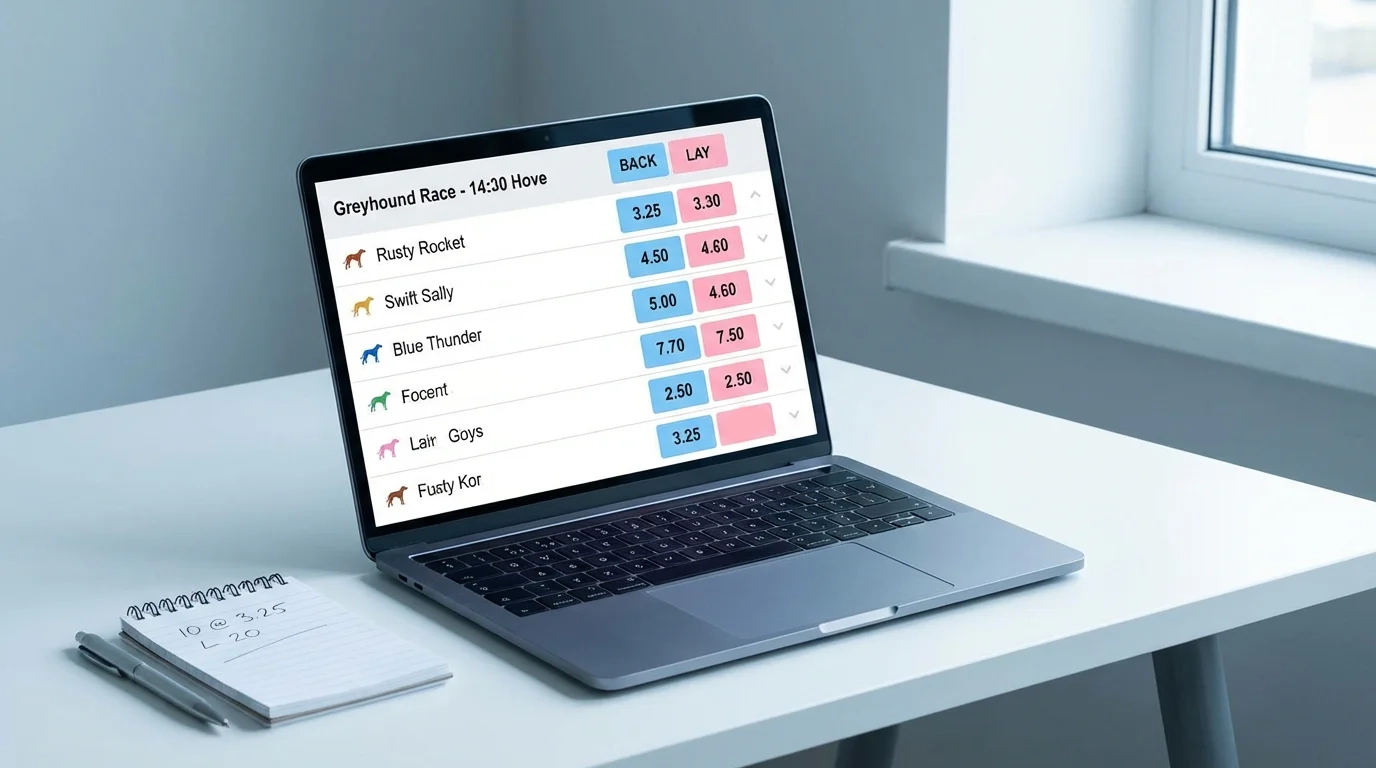
The exchange displays two columns of odds for each dog in a race: back odds and lay odds. The back price is the best odds currently available if you want to bet on the dog to win. The lay price is the best odds currently available if you want to bet against the dog winning. Between the two is a small spread — the gap between what backers are willing to accept and what layers are willing to offer.
When you place a back bet on the exchange, your bet is matched against another user’s lay bet. If no one is currently offering to lay at the price you want, your bet sits in the market as an unmatched offer until someone accepts it or the race starts. Similarly, if you place a lay bet, it waits for a backer to match it. This matching mechanism is what makes the exchange a true marketplace — prices are determined by supply and demand between participants, not by a bookmaker’s trading desk.
The commission model replaces the bookmaker’s overround. On traditional bookmaker markets, the odds on all runners in a greyhound race add up to more than 100% — the excess is the bookmaker’s margin. On the exchange, the market can trade at close to 100% because there’s no built-in overround. Instead, Betfair charges a commission on net winnings — the standard rate under the My Betfair Rewards system ranges from 2% to 6% depending on which package you choose, with the default Rewards package set at 6% since June 2025. If you win £100 on a back bet, Betfair takes £6 and you receive £94. If you lose, you pay nothing in commission — you’ve simply lost your stake to the person on the other side of the bet.
For greyhound racing specifically, exchange markets are available on most GBGB meetings, though market depth varies significantly. Major evening meetings at popular tracks — Romford, Monmore, Nottingham — tend to have the best liquidity, with meaningful amounts of money traded on each race. Afternoon BAGS meetings carry thinner markets, and some lower-profile fixtures may have very little money available, which can make getting matched at a fair price difficult.
The exchange also supports in-play betting on greyhound races, though the practical window is even narrower than on bookmaker apps. The odds update in real time based on the race unfolding, and bets can be placed and matched during the race. The latency and speed issues that affect bookmaker in-play betting apply equally on the exchange, with the additional complication that your bet needs to find a counterparty — in a 30-second race, unmatched bets are a real possibility.
One structural advantage of the exchange for greyhound bettors is the absence of account restrictions. Traditional bookmakers routinely limit or close the accounts of profitable bettors — a practice that’s legal, common, and deeply frustrating for anyone who has developed an edge. Betfair Exchange, by contrast, has no incentive to restrict winning accounts because the platform earns commission on every winning bet regardless of who placed it. Profitable greyhound bettors can operate on the exchange indefinitely without facing the account management that plagues their bookmaker activity.
Backing vs Laying Greyhounds
Backing on the exchange is functionally identical to backing with a bookmaker — you bet on a dog to win, and if it does, you collect the payout minus commission. The difference is that the odds are often slightly better because the exchange market is more competitive. Where a bookmaker might offer 4/1 on a selection, the exchange back price might be 4.5 or 4.8 in decimal — a meaningful improvement that compounds over hundreds of bets.
Laying is the exchange-exclusive capability. When you lay a dog, you’re betting it won’t win. You accept a liability equal to the potential payout if the dog wins, and you collect the backer’s stake if it doesn’t. If you lay a dog at 5.0 (4/1) for £10, your liability is £40 — the amount you’d pay if the dog wins. If the dog loses, you keep the backer’s £10 stake minus commission.
Laying is most useful in greyhound racing when you have a strong opinion that a specific dog is overrated by the market. A favourite at 2/1 that you assess as a genuine 4/1 chance is a lay candidate — the market is underpricing its probability of losing. This is the mirror image of a value back bet: instead of backing an underpriced dog, you’re opposing an overpriced one. The analysis is the same; the direction of the bet is reversed.
The risk profile of laying requires careful attention. When you back a dog, your maximum loss is your stake. When you lay a dog, your maximum loss is the liability — which can be substantially larger than the stake you collect. Laying a 10/1 outsider at £10 means accepting £100 in liability for the chance to win £10. The payoff ratio is inverted compared to backing, which means laying is most appropriate on shorter-priced selections where the liability-to-reward ratio is more balanced. Laying a 2/1 shot at £10 means accepting £20 in liability — a more manageable risk that reflects a genuine analytical opinion about the dog’s chance.
Trading — combining back and lay bets on the same selection at different prices — is the most sophisticated use of the exchange. If you back a dog at 6.0 and the price shortens to 4.0 before the race, you can lay it at 4.0 to lock in a profit regardless of the outcome. This technique is common in horse racing exchange trading but is harder to execute in greyhound racing because the markets are thinner and the price movements less predictable. It’s possible on major evening meetings with decent liquidity, but impractical on lower-profile fixtures where the spread between back and lay prices is too wide.
Liquidity and Market Timing on Dog Races
The biggest practical limitation of exchange greyhound betting is liquidity — the amount of money available in the market. Greyhound exchange markets are significantly thinner than horse racing markets, which means getting matched at your desired price isn’t always possible, and large bets can move the market against you.
Liquidity tends to arrive late. On a typical greyhound race, the exchange market may show very little money until 10 to 15 minutes before the off. The final five minutes see the bulk of the volume, as bettors who have studied the racecard and observed the early market movements place their positions. If you want to back at a specific price, placing your order early — as an unmatched offer sitting in the market — gives you the best chance of being matched if the price reaches your level. Waiting until the last few minutes means competing with the late rush of money, which can compress the odds quickly.
For lay bets, the timing dynamic is reversed. Laying early, when the market is thin, risks offering a price that more informed late money won’t validate. Laying closer to the off, when the market has absorbed more information, gives you a more reliable picture of the true probabilities — though you may have to accept a shorter price.
The Exchange Rewards a Different Kind of Punter
Betfair Exchange isn’t a replacement for bookmaker betting on greyhounds — it’s a complement. The bookmaker interface is simpler, the markets are guaranteed to fill, and features like Best Odds Guaranteed and free bet promotions don’t exist on the exchange. For straightforward win betting on greyhound racing, a bookmaker app remains the most convenient option for most bettors.
The exchange comes into its own for bettors who want to lay selections, who are trading odds movements rather than simply backing dogs to win, or who need a platform where profitable betting isn’t penalised. It rewards patience, market awareness, and the willingness to engage with a more complex interface. The commission model means your winning bets pay slightly less than the headline odds, but the better base prices can more than compensate for that cost.
If you’ve reached the point where your greyhound betting is consistently profitable — and especially if bookmaker platforms have started closing doors — the exchange is the natural next step. The dogs are the same. The races are the same. The marketplace is different, and that difference creates opportunities that the traditional model doesn’t offer.