Greyhound Betting Odds Explained
Best Greyhound Betting Sites – Bet on Greyhounds in 2026
Loading...
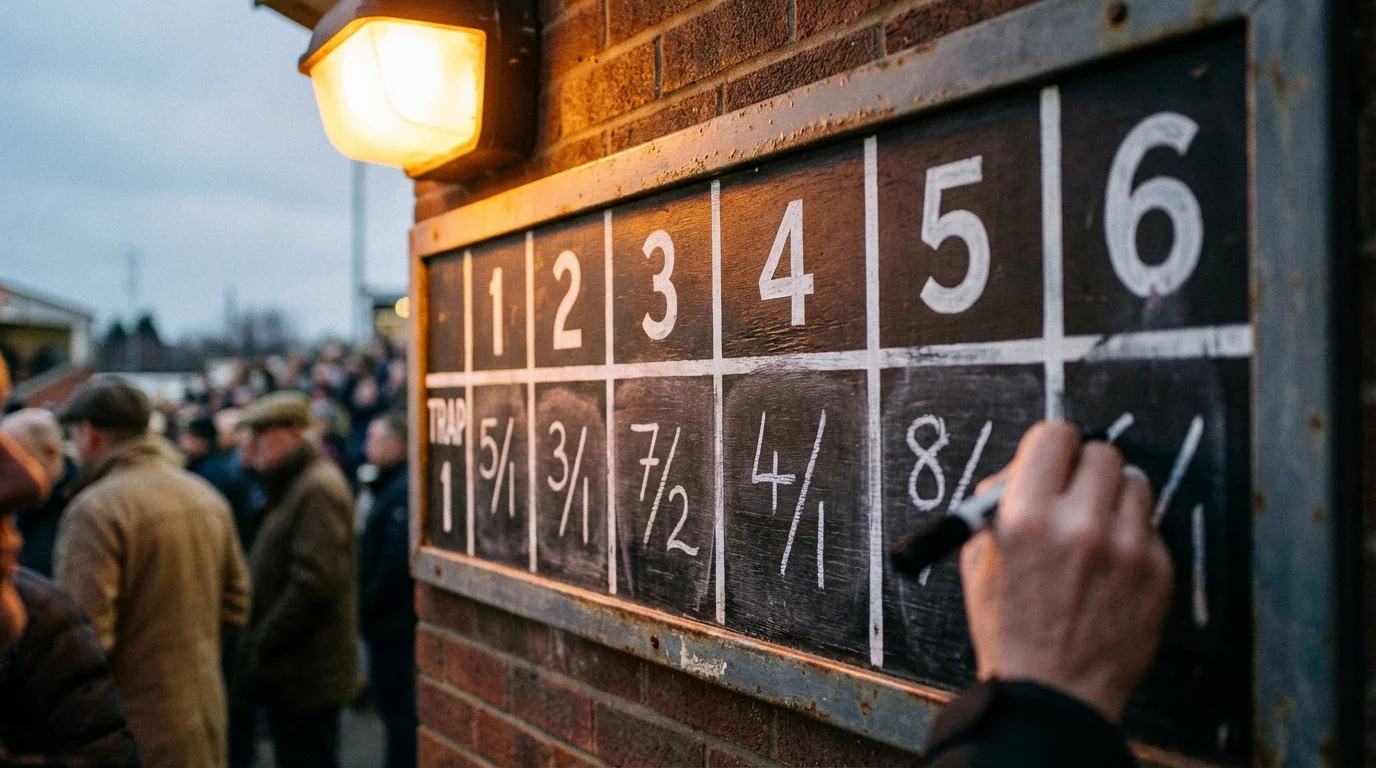
Greyhound Odds Aren’t Just Prices — They’re Information
Every price on the board is a statement about probability. Your job is to disagree. That’s the simplest description of what profitable greyhound betting looks like: the bookmaker prices a dog at 5/1, you believe its true chance is closer to 3/1, and you back it because the gap between those two assessments represents value. Without understanding what odds actually mean — how they’re formed, what they express, and where they’re wrong — you’re betting blind, regardless of how much form study you’ve done.
Odds in greyhound racing serve the same function as prices in any market. They represent the collective assessment of probability, distorted by a built-in margin that ensures the bookmaker profits over time. A dog priced at 4/1 isn’t exactly a 20% chance of winning — it’s a 20% chance with the bookmaker’s margin removed. The true implied probability is slightly lower, because the odds on all six dogs in a race add up to more than 100%. That excess is the overround, and it’s how the bookmaker guarantees a profit regardless of which dog wins.
For bettors, understanding odds goes beyond knowing that 4/1 returns £5 for every £1 staked. It means recognising that odds are imperfect estimates of probability, shaped by market forces, bookmaker models, and public perception — all of which can deviate from reality in ways that create opportunity.
Fractional, Decimal and American Odds in Dog Racing
UK bookmakers default to fractional. Your app might show decimal. Both mean the same thing. The three major odds formats you’ll encounter in greyhound betting express the same underlying information — potential return relative to stake — in different mathematical notation. Which one you use is a matter of preference and geography, but being comfortable converting between them is a practical skill, especially if you use multiple betting platforms.
Fractional odds are the UK standard. Written as 5/1, 7/2, 11/4, or 4/6, they express the profit relative to the stake. At 5/1, you win £5 for every £1 staked. At 7/2, you win £7 for every £2 staked, or £3.50 per £1. For fractions below even money, the denominator is larger than the numerator: 4/6 means you win £4 for every £6 staked, or roughly 67p per £1. The total return is always the profit plus your original stake.
Decimal odds, common in Europe and increasingly available on UK apps, express the total return per unit staked rather than just the profit. A 5/1 fractional price becomes 6.00 in decimal — you receive £6 total for a £1 stake, of which £5 is profit and £1 is your stake returned. The conversion formula is simple: divide the fractional numerator by the denominator and add 1. So 7/2 becomes (7 divided by 2) + 1 = 4.50. Decimal odds are mathematically cleaner for calculating returns on multiple bets and for comparing prices quickly, which is why many serious bettors prefer them.
American odds, expressed as +500 or -150, are rarely encountered in UK greyhound betting but may appear on international platforms. Positive numbers show the profit on a $100 stake (+500 means $500 profit). Negative numbers show how much you need to stake to win $100 (-150 means you stake $150 to win $100). For UK greyhound betting, you can safely ignore American odds unless you’re using a US-based exchange or sportsbook.
Most UK betting apps let you switch between fractional and decimal in the settings menu. If you haven’t tried decimal, it’s worth experimenting — the format makes value comparisons between dogs faster because you’re comparing single numbers rather than fractions. A dog at 4.50 is instantly, visually distinguishable from one at 5.00 in a way that 7/2 versus 4/1 sometimes isn’t at a glance.
One more term that appears on greyhound racecards: SP, or starting price. This isn’t a fixed number you’ll see before the race — it’s the final price at which the dog is offered when the traps open, determined by the on-course market. If you bet at SP rather than taking a fixed price, your bet is settled at whatever the starting price turns out to be. SP betting was the traditional default in UK racing and still appears as an option on most apps, though the trend has moved firmly towards fixed-price betting where you lock in your odds at the moment you place the bet.
How Greyhound Odds Are Set — Bookmakers vs the Market
Opening prices, market movers, on-course intelligence — the odds tell a story. Greyhound odds don’t appear from nowhere. They’re the product of a pricing process that begins with bookmaker models and evolves through market activity in the hours and minutes before a race.
The process starts with opening prices, which are set by the bookmaker’s trading team based on form data, historical trends, and statistical models. For a graded race at Romford on a Tuesday evening, the traders will assess each dog’s recent form, its grade, its trap draw, and the likely pace scenario. From this analysis, they assign initial odds that reflect their estimate of each dog’s winning probability, with the overround built in. These opening prices are published — typically several hours before the race on main evening cards, and sometimes only minutes before on lower-profile BAGS fixtures.
Once the prices are live, the market takes over. Money arrives from bettors, and the odds adjust in response. If a disproportionate amount of money comes in for Trap 3, the bookmaker shortens the price on Trap 3 and pushes out the prices on the other dogs to maintain the overround. These market movements carry information. A significant shortening — often called a “steamer” — can indicate that informed money considers the dog’s chance better than the opening price suggested. A drift — the price getting longer — can signal that informed bettors are avoiding the dog, though it can also simply mean public money is flowing elsewhere.
In greyhound racing specifically, the on-course market plays a smaller role than in horse racing. There are no on-course bookmakers at greyhound tracks in the way there are at racecourses. The SP is derived from the off-course market, primarily the prices offered by the major bookmakers at the point the traps open. This means the greyhound SP is essentially a snapshot of the bookmaker market at race time, rather than an independent on-course assessment.
For bettors, the practical implication is that early-morning or early-afternoon prices on greyhound races are often less refined than the prices available closer to the off. The opening market carries the bookmaker’s best guess, but it hasn’t been tested by money. As bets arrive and the market adjusts, the odds become a more accurate reflection of collective opinion. Whether you prefer to bet early (to capture potential value before the market corrects) or late (to benefit from a more informed market) depends on your confidence in your own analysis relative to the crowd’s.
Finding Value in Greyhound Betting Odds
Value means the price is bigger than the real probability. That’s the whole game. Every profitable bettor, in greyhound racing or any other sport, operates on this single principle: back selections where the odds offered exceed the true probability of the outcome, and avoid selections where they don’t. The difficulty lies in estimating that true probability accurately enough to distinguish value from noise.
In a six-dog greyhound race, the bookmaker’s odds imply a probability for each runner. If the favourite is 2/1, the implied probability (before the overround) is about 33%. If you believe, based on your form analysis, trap draw study, and understanding of the race dynamics, that the dog’s actual chance of winning is 40%, you’ve found value. The price is offering you a 33% probability, but you think the reality is 40%. Over a large number of such bets, the gap between your estimated probability and the market’s assumed probability is where profit accumulates.
The challenge in greyhound racing is that six-dog fields produce a naturally compressed odds range. Favourites are rarely longer than 5/2, and outsiders are rarely longer than 12/1. The windows for value are narrower than in horse racing, where 20-runner handicaps produce prices across a much wider spread. This means the value you find in greyhound racing tends to be marginal — a dog priced at 4/1 that you think is really a 3/1 chance — rather than dramatic. Those marginal edges are still profitable over volume, but they demand discipline and consistency rather than occasional big wins.
One practical value indicator in greyhound racing is the relationship between trap draw and price. At tracks with documented inside-trap bias, a dog drawn in Trap 1 or Trap 2 whose price doesn’t fully reflect that positional advantage represents potential value. The market accounts for trap draw to some extent, but not always completely — particularly in lower-profile BAGS races where the opening prices receive less market scrutiny. Similarly, a dog dropping in grade whose price still reflects its recent poor finishing positions, rather than the quality of opposition it was facing, is a classic value candidate.
The discipline required is to bet only when you’ve identified a genuine discrepancy between the odds and the probability, and to walk away when you haven’t. Most races won’t offer value on any runner. That’s normal. The bettor who bets on every race regardless is paying the bookmaker’s margin on every bet, and no amount of form study can overcome that structural cost. Selectivity isn’t just preferable — it’s mathematically necessary.
Odds Don’t Predict — They React
The market isn’t always right. But it’s always worth listening to. Odds are the distilled opinion of thousands of bettors and a bookmaker’s pricing model, and as such they contain real information about a dog’s perceived chance. Dismissing the odds entirely — “the market is wrong, I know better” — is as dangerous as following them blindly.
The productive relationship with greyhound odds is one of informed scepticism. You check the price, you note what it implies, and then you compare it against your own assessment. Sometimes you agree with the market and the bet offers no value. Sometimes you disagree and back your own analysis. The key is that the disagreement is grounded in evidence — a form reading, a trap draw advantage, a grade change the market hasn’t adjusted for — rather than in wishful thinking.
Odds are reactive, not predictive. They respond to information as it arrives — money in the market, late changes, public sentiment — but they don’t know the future. Neither do you. The difference between a good bettor and a poor one isn’t the ability to predict outcomes. It’s the ability to assess probabilities more accurately than the market, more often than not. The odds are your benchmark. Beat the benchmark often enough, and the maths works in your favour. That’s all any bettor can ask for.