Greyhound Accumulators — How to Build & Manage Multi-Bets
Best Greyhound Betting Sites – Bet on Greyhounds in 2026
Loading...
The Appeal and the Trap of Greyhound Accumulators
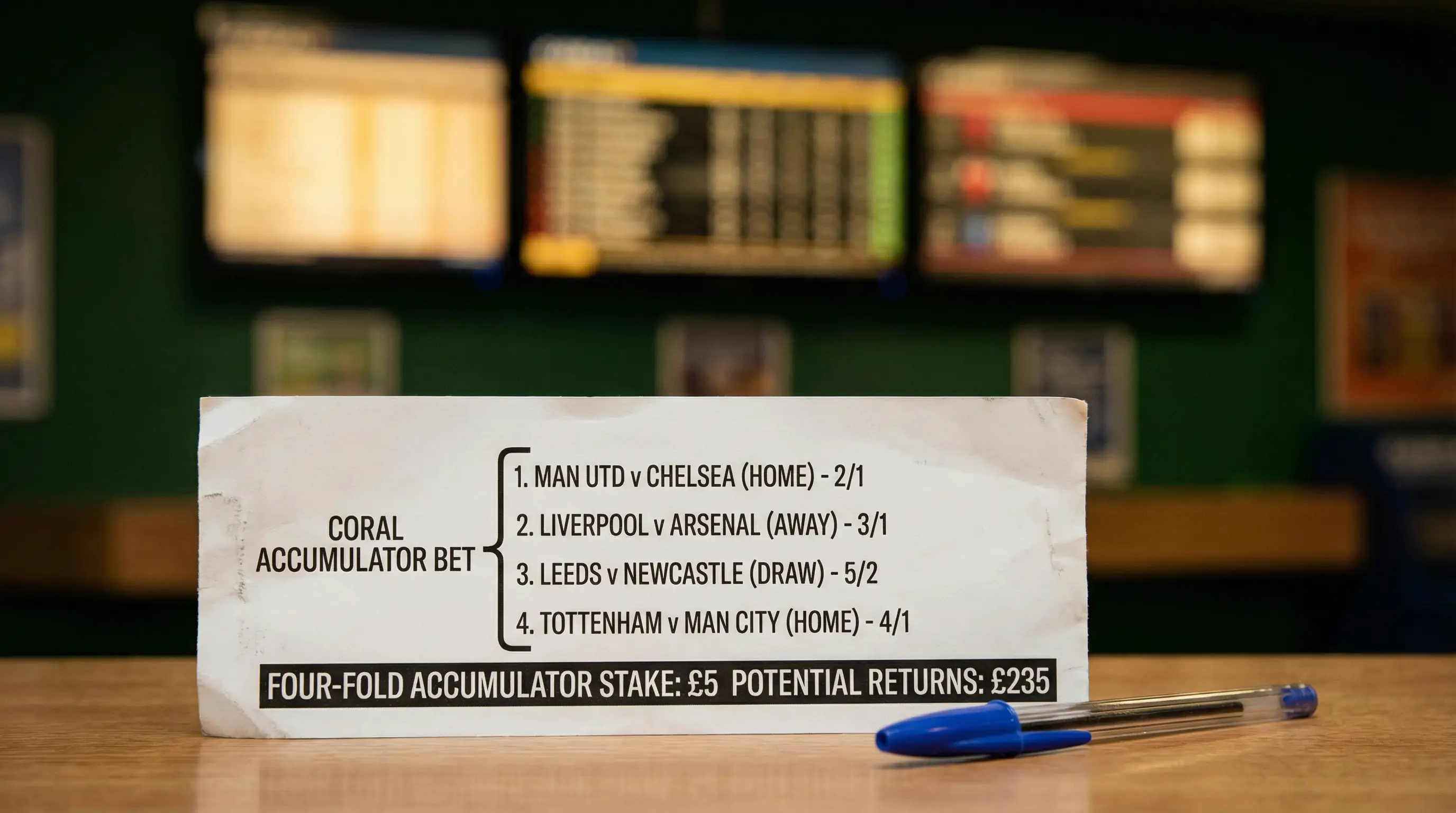
Accumulators are the most popular bet type by volume on UK betting apps, and greyhound racing is no exception. The format is simple — combine multiple selections into a single bet where the returns from each winning leg roll into the next — and the potential payouts are eye-catching. Four dogs at 3/1 each produces a theoretical return of over £250 from a £1 stake. The maths is seductive. The reality is considerably harder.
Greyhound accumulators carry a specific appeal that sets them apart from football or horse racing multiples. The races are short, the results come quickly, and a four-leg acca across a single evening meeting can be settled within two hours. There’s no waiting until Sunday for the final leg. The pace matches the sport — fast, decisive, and complete before the night is over.
But that pace also amplifies the structural problem with accumulators: the bookmaker’s margin compounds with every leg you add. A single bet at the bookmaker’s standard overround might cost you 5-8% in expected value. A four-leg accumulator compounds that margin four times. By the time you’ve assembled a six-fold on greyhound racing, the mathematical expectation is deeply negative — regardless of the quality of your individual selections. Understanding how accumulators actually work, and where they can be used without destroying your bankroll, is the difference between entertainment and expensive habit.
How Greyhound Accas Work
An accumulator links two or more selections into a single bet. Every selection must win for the bet to pay out. The returns from the first winning leg become the stake on the second, and so on through every leg until the final selection either wins — completing the accumulator — or loses, at which point the entire bet is settled as a loser.
The terminology scales with the number of legs. A two-selection accumulator is a double. Three selections is a treble. Four or more are typically referred to by number — four-fold, five-fold, six-fold. The payout calculation is straightforward: multiply the decimal odds of each selection together and multiply by your stake. A treble at 3.00, 4.00, and 2.50 (decimal) returns 3.00 × 4.00 × 2.50 × stake = 30 times your stake. On a £2 bet, that’s £60.
Most UK betting apps make accumulator construction simple. You tap each selection to add it to your betslip, and the app automatically offers the accumulator option alongside the individual singles. The slip shows the combined odds and the potential return, updating in real time as you add or remove legs. Some apps also suggest “acca boosts” — promotional enhancements that increase the payout by a percentage if all legs win. These boosts are genuine added value, though they don’t change the underlying probability of the bet landing.
Each-way accumulators are available on greyhound racing but are less common than win-only multiples. In an each-way acca, each selection generates two potential payouts — the win part and the place part. If one leg wins and another places, the win portion of the accumulator dies but the place portion continues. The maths is more complex, but each-way accas offer a softer landing than win-only multiples because a placed selection doesn’t kill the entire bet — just the win component.
The critical point that the betslip doesn’t highlight is the probability. A four-leg accumulator where each selection has a 25% chance of winning — roughly a 3/1 shot — has an overall probability of landing of 0.25 × 0.25 × 0.25 × 0.25 = 0.39%. That’s less than one in 250 attempts. The payout reflects this low probability, which is why the numbers look attractive. But “less than one in 250” is not a number that rewards regular staking.
Choosing Legs for a Dog Racing Accumulator
If you’re going to build greyhound accumulators — and most bettors will, at least occasionally — the selection process matters more than it does for singles. In a single bet, a marginal selection costs you one stake. In an accumulator, a weak leg destroys the entire bet, wasting the value generated by every other winning selection in the chain.
The first principle is that every leg should stand on its own merit. Each selection in the accumulator should be a bet you’d be willing to place as a single. If you wouldn’t back a dog at 2/1 as a standalone bet, it doesn’t belong in your accumulator just because it “looks solid.” The accumulator doesn’t improve a mediocre selection — it amplifies both the upside and the downside. A dog you’re uncertain about as a single becomes a liability as an acca leg.
Keep the number of legs low. The mathematical penalty for adding legs is exponential, not linear. A double compounds the margin twice. A treble, three times. By the time you reach a six-fold, the accumulated margin makes the bet a poor proposition regardless of selection quality. Two or three legs is the practical ceiling for greyhound accumulators where form analysis still has meaningful influence on the outcome. Beyond three, you’re increasingly relying on luck rather than judgement, which undermines the entire purpose of studying form.
Avoid mixing races from the same meeting unless you’re confident about the independence of the fields. Greyhound meetings at the same track on the same evening share conditions — surface, weather, trap bias — and a misjudgement about those conditions can sink multiple legs simultaneously. If the track is riding slower than expected and you’ve backed two front-runners across different races, both legs are compromised by the same environmental factor. Spreading your legs across different meetings or different tracks reduces this correlated risk.
Favour selections with clear, identifiable advantages rather than marginal calls. A dog with a documented trap advantage at its home track, dropping in grade, with consistent recent form, is a stronger acca leg than a dog whose case relies on a single encouraging run. The accumulator needs every leg to win, so each selection should be the kind you have genuine conviction about — not a tentative opinion dressed up as confidence because the acca needs another leg.
Risk and Reward — Realistic Acca Expectations
The honest assessment of greyhound accumulators is that they are a negative-expectation bet type for the vast majority of bettors. The compounding margin erodes expected returns more aggressively than single bets, and the low landing probability means that winning accumulators are infrequent events separated by long stretches of losing ones.
Consider a bettor who places a £5 four-fold every evening across a 12-race card. Over a month of regular betting — say 20 meetings — that’s £100 in acca stakes. The probability of each four-fold landing, assuming well-chosen selections with a 30% individual win rate, is approximately 0.8%. Over 20 attempts, the expected number of winners is 0.16 — meaning the bettor is likely to go an entire month without a single accumulator landing. The occasional payout will be substantial, but the frequency of losses means the running cost is relentless.
Compare that to the same bettor placing 80 individual singles over the same period at £5 each. The strike rate on singles at 30% means roughly 24 winners, providing regular returns that can be tracked, analysed, and improved. The singles approach produces data you can learn from. The accumulator approach produces a month of losses punctuated by the occasional windfall that may or may not cover the accumulated stakes.
This doesn’t mean accumulators should never be placed. It means they should be sized and framed appropriately. An accumulator is a high-risk, high-reward position that should consume a small fraction of your overall betting activity — perhaps 5% to 10% of your weekly staking budget, treated as a supplementary bet rather than a core strategy. The main body of your betting should be singles, where your form analysis has the most direct impact on returns and where the bookmaker’s margin is paid only once per bet.
Acca insurance and boost promotions can shift the maths marginally in your favour on specific bets. If a bookmaker offers money back as a free bet if one leg of your five-fold loses, the effective probability of a return from the accumulator increases. These promotions are worth using when they’re available, but they don’t transform the structural economics of multi-bets. They soften the edges; they don’t eliminate them.
Accumulators Are Amplifiers, Not Strategies
An accumulator amplifies your selections. If your selections are good — form-based, value-driven, selected with discipline — the accumulator amplifies quality. If your selections are lazy — chosen to fill legs, based on convenience rather than conviction — the accumulator amplifies poor judgement. The format itself is neutral. What it does to your returns depends entirely on what you feed into it.
The bettors who use greyhound accumulators most effectively treat them as occasional extras rather than primary bet types. Their core activity is singles. Their accumulator is a small-stake double or treble built from their strongest selections of the evening — dogs they’ve already backed individually and feel confident about combining. The accumulator isn’t the plan; it’s the bonus on top of a plan that’s already grounded in analysis.
If you find that accumulators are consuming the majority of your betting stake, that’s a signal to reassess. The appeal of big payouts from small stakes is powerful, but the maths that produces those payouts is the same maths that produces long losing runs. Keep accas small, keep them infrequent, and keep them populated only with selections you’d be proud to back as singles. That’s the line between using accumulators as a tool and being used by them.